AI
Why AI Agents Forget by Design
AI agent memory failures aren't a bug. Statelessness is the architecture every major LLM provider chose, and the bill for that decision shows up every month.
Every repository I work in has a file whose only job is to tell my AI agent the things I already told it before. One line in mine says a certain content folder is named in the singular, because I corrected that exact mistake more than once before giving up and writing it down. Another line just bans a punctuation mark, long story. The file earns its keep, I maintain it carefully, and every so often I notice what it actually is: me doing the remembering for the machine that was supposed to remember for me.
The agent is not broken. This is how the whole stack is designed to work, and the design is worth understanding before you spend money working around it. Every major LLM API is stateless, so what an agent “remembers” is whatever your application pastes back into the request. That is the entirety of AI agent memory at the inference layer in 2026, it is the single biggest source of production friction in agentic systems shipping today, and the bill for it lands somewhere on every invoice and every team calendar.
Why AI agents forget by design
The OpenAI Chat Completions API, Anthropic’s Messages API, and Google’s Gemini API share one property that gets surprisingly little attention in the agent literature: every call is independent. The server holds no session, no user identity, no record of prior turns. Anthropic’s docs say it plainly: the client is responsible for sending the full conversation history on every call. OpenAI’s newer Responses API offers a server-side conversation object as a convenience layer, but the inference call underneath it is still stateless.
The engineering reasons are solid. Stateless inference scales horizontally without sticky sessions, load balancing stays trivial, and a whole class of state bugs never gets written in the first place. There is a second reason, less talked about: stored memory is a liability. The moment a provider persists what your users said, it owns everything that comes with that - who can read it, how long it lives, how deletion works, what happens when a regulator or a lawyer asks for it. A stateless API carries none of that, tokens in, tokens out, nothing stays. For the provider, statelessness is the right call.
For you, building on top, it means there is no memory feature to switch on. There is the context window you fill on each request, and whatever scaffolding you build around it.
from anthropic import Anthropic

client = Anthropic()
model = "claude-sonnet-4-6"

# Turn 1: the user provides their account number
response_1 = client.messages.create(
    model=model,
    max_tokens=200,
    messages=[
        {"role": "user", "content": "My account number is ACME-48201. I can't log in."}
    ],
)
print(response_1.content[0].text)
# -> "Thanks for sharing that. To help with login issues, could you tell me..."

# Turn 2: a new request, no history passed. The model has no recall.
response_2 = client.messages.create(
    model=model,
    max_tokens=200,
    messages=[
        {"role": "user", "content": "Did the login work yet?"}
    ],
)
print(response_2.content[0].text)
# -> "I'd be happy to help. Could you share your account number so I can check?"
The second call has no idea the first one happened. To the API these are two unrelated requests arriving on the same key. If your agent should “remember” the account number, your harness has to put it back into the messages array on the next call, and on every call after that.
The context window is not memory
The obvious response: fine, we resend everything every time. Most production agents do exactly that, and it works for a while.
Cost: re-sending 50K tokens of conversation history every turn adds up fast. At Claude Sonnet 4.6 input pricing of $3 per million tokens (as of July 2026), a 100-turn session with 50K of average resent context costs $15 in input alone, before output and before tool calls. Prompt caching blunts this within a session, since conversation history is an append-only prefix (the textbook caching case) and cache reads run at a tenth of the base input price. But the default cache lives 5 minutes and human think-time between turns routinely outlasts it, the 1-hour tier doubles the write cost, and no cache survives across sessions, users, or model swaps. Caching makes the resend cheaper, it does not remove the architecture that requires it.
Latency: bigger contexts mean longer time-to-first-token. Users notice it in milliseconds. Agents that run hundreds of internal turns stack those milliseconds into minutes on every task.
And the one teams underestimate: long context degrades the model itself. The Lost-in-the-Middle paper by Liu et al. showed that language models, including the long-context flagships, retrieve information from the beginning and end of a long context far more reliably than from the middle. A fact buried in turn 12 of a 40-turn conversation is statistically less likely to influence the answer than the same fact pasted into the latest user message. The model is not lying when it says it does not remember, it often genuinely cannot find what is sitting right in front of it.
The window is a working area. The mental model I use comes from the systems world: context is a CPU cache, not a database. Finite, expensive, performance sensitive, optimized for immediate computation rather than long-term retention. A cache that big is still a cache. Bigger context windows are a memory workaround, not a memory architecture. A 1M-token window costs $3 in input to fill on Sonnet 4.6 and $10 on Claude Fable 5 as of July 2026 (per request, not per session), takes meaningful seconds to process, and still will not reliably surface a specific fact from the middle. Stuffing more in is not the path forward.
Four production failures that lack of memory creates
Run an agent in front of real users for a few weeks and the architecture stops being abstract. It shows up as 4 failures, and I meet the first one every working morning.
Re-explanation is the daily one. Every session starts at zero, so the user who has been with your product for six months teaches the agent who they are, what they work on, and which conventions they prefer, again. In my own work the pattern got so predictable that I institutionalized the fix: that standing-rules file from the top of this piece exists because re-explaining is cheaper than re-discovering, and writing it down is cheaper than either. Somewhere around the second month of working this way you notice the role reversal. The agent is not remembering for you, you are remembering for it, and you are the only one in the loop who feels each repetition.
Handoff loss is the team-scale version of the same bill. A session ends and whatever the agent learned, deduced, or established evaporates with it. The next session, whether it is you tomorrow or a teammate on the same problem an hour later, starts from the blank slate. Engineering teams using Cursor or Claude Code live this every morning: yesterday’s architectural decisions, naming conventions, and gotchas get re-loaded into the new chat by a human who remembered them.
Contradiction without resolution is quieter and worse. Today the user tells the agent the project runs on Postgres. Tomorrow, after a migration, they say DuckDB. A memory system that appends both facts now holds two contradictory entries and no mechanism for deciding which one is current. Vector-store implementations have no native concept of a newer fact superseding an older one: both get retrieved, the model picks by semantic similarity, and the user finds out when the generated code targets the wrong database.
And when the model has no relevant memory at all, it tends to do the worst available thing: guess fluently. Most agent memory setups cannot distinguish a confident retrieval from an empty one, so the model has no structural reason not to confabulate. An agent that could say “I don’t have a memory of your previous deployment configuration, can you remind me?” would be more useful than one that invents a plausible answer. The structural reasons why agents guess instead of saying “I don’t know” deserve separate treatment.
Four symptoms, one root cause, and fixing them takes more than a bigger window or a better embedding model.
The five memory layers inside a modern agent
An agent’s day looks nothing like a chat. It browses, calls tools, reads files, and gets back diverse, unstructured, often enormous responses that flood the context far faster than a human conversation ever did. That pressure is why serious agent implementations grew real memory machinery around the model: storing, condensation and retrieval. After building several personal agents and reading the popular open-source implementations like OpenClaw, I see that machinery as 5 layers. Memory is not one thing, it is several systems interacting, each with different constraints. The layout is practical rather than academic, and it pays off by separating storage from selection and persistence from attention, which is where most real failures occur.
- working memory: the tokens the model actually sees this step - instructions, recent dialogue, whatever structures are in the window. Reassembled every step, durable for exactly one. Windows keep growing, but context rot is real, and a context is a finite attention budget with diminishing returns
- session memory: continuity across turns. The harness keeps the user and agent messages plus tool results so nothing has to be stitched together by hand each turn, as client-side history or a server-side convenience object like OpenAI’s Responses API. Scoped to one session, and it still grows without bound if nobody manages it
- condensed memory: what happens at the limit. Compaction summarizes everything before a boundary and injects the summary back as a synthetic turn. It loses detail by design, and irreversible compression is tricky because you cannot recover the conversation that turned out to matter later. Condensation is where correctness gets traded for efficiency
- durable memory: what survives across sessions - instructions, preferences, long-lived facts. Curated, not raw transcripts. In practice this is often just markdown the agent re-reads: CLAUDE.md, AGENTS.md, my standing-rules file. The better setups distill session notes into consolidated global notes, and deduplication plus conflict resolution do the real work there
- retrieval memory: the index that brings the durable store into attention at the moment of need - semantic search, keyword search, metadata navigation, paths, links, stored queries. Anthropic’s engineering guidance calls the pattern just-in-time context: keep lightweight identifiers around and load the actual data through tools at runtime
One note on the taxonomy: condensed memory is really a process, the summary physically lives in session memory. It behaves so differently from what it replaced that it is worth treating as its own layer anyway.
Memory failures in these agents are usually not as simple as agents forgetting. It happens between the boundaries of the layers. The model starts ignoring early instructions because attention decayed across an overloaded window. Tool traces bloat the session and push the reasoning out. A compaction summary drops the one constraint that mattered, and the agent makes a confident decision against incomplete history. Old preferences in the durable store override newer instructions, or two conflicting facts coexist with no resolution. And retrieval misses: the correct memory exists, but it is never retrieved at the right time, or an irrelevant one gets injected instead. Every failure from the previous section is one of these boundary crossings, seen from the user’s side.
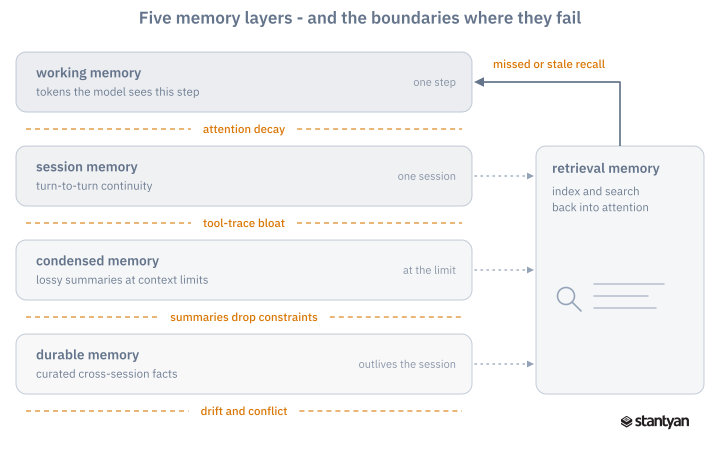
Each layer holds. The failures happen at the crossings between them, where state is dropped, compressed, or never retrieved.
What teams actually do today, and why each approach falls short
Every mitigation pattern teams run today is a partial implementation of one or two of those five layers. None of them solves the underlying problem, and most of them help in narrow circumstances. What teams actually run, with the honest caveat on each:
- prompt stuffing: cram more relevant context into the system prompt or the latest message. Cheap, fast, breaks down past a few thousand tokens, walks straight into Lost-in-the-Middle
- fine-tuning: bake the knowledge into the weights. Strong for stable domain knowledge, useless for facts that change weekly or differ per user, brutal to iterate on
- retrieval-augmented generation: pull relevant chunks from a knowledge base at inference time. Good for documents and reference material, weaker for conversational state that shifts turn by turn
- vector databases: embed prior conversation, retrieve by semantic similarity. The most common pattern in 2026 and the one most often confused with memory. It retrieves text. Vector databases alone aren’t enough, and treating them as a memory primitive papers over real architectural gaps
- conversation summarization: compress older turns into a running summary that stays in context. Lossy by construction, and the summarizer is itself a stateless model guessing what will matter three sessions from now
- custom wrappers, and a growing shelf of agent memory libraries that bundle the patterns above: they reduce engineering toil, they mostly share the same shape, and they do not, individually, touch the temporal, structural, or abstention gaps
The platform vendors are moving too: Anthropic’s Claude Tag, launched in June 2026, gives Claude channel-scoped persistent memory inside Slack.
Most production agents combine two or three of these, and the combination ships a perfectly fine demo. By month six the same handful of issues cycles through customer feedback, because every pattern on that list treats a symptom it can see rather than the architecture underneath.
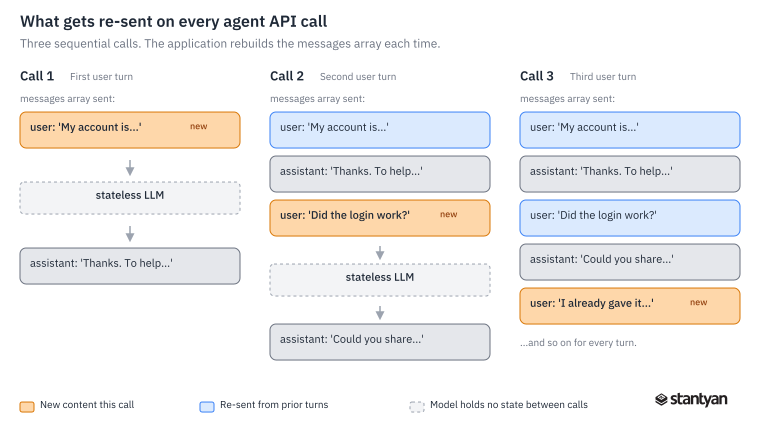
Every call to a stateless LLM API rebuilds context from whatever the application chose to keep. The model itself remembers nothing between requests.
The temporal problem nobody talks about
Solve the storage problem perfectly and a harder one is still waiting underneath: time.
At some point my tools stored the fact that I work at Aiven, because I said so, and it was true. It has not been true for a while. The fact still sits wherever it landed, it still embeds to roughly the same vector, and it still comes back when something work-related gets asked. It is confidently wrong, and nothing in a similarity score can tell you that.
Retrieval today runs on semantic similarity, sometimes with recency weighting layered on. Neither expresses what a memory actually needs to say: when this was learned, when it was true, and whether anything since has superseded it. Those are two separate clocks, the time a fact entered the system and the window over which it held, and most current implementations track neither of them cleanly.
The result is a bug class that looks like hallucination and is harder to catch, because the system can point at a real source. The source is simply out of date, so it survives review. Of everything in this piece, this is the problem most likely to decide which agent-memory architectures still look credible in three years and which end up looking the way early-2020s blockchain pitches look today.
A good memory system does not store more, it forgets better
Almost every memory conversation gets this backwards: the quality that separates a good memory system is not bigger or more sophisticated storage, it is better forgetting. The stale employer fact from the previous section survived because nothing in the system was responsible for retiring it. The need for forgetting is not a bug: window sizes keep improving, and unbounded context growth still degrades response quality over time, the same Lost-in-the-Middle mechanics from earlier applied continuously.
Forgetting better does not mean blindly deleting by recency. It means keeping the smallest set of high-value tokens that maximizes output quality, and dropping what is superfluous and safe to drop. Easier said than done. In most cases it might be better to keep the wrong stuff in than to accidentally delete the right stuff, so the policies need real nuance and a clear bias toward preserving evidence and decisions. The pattern I trust most: condensation drops old events from the attention stream and inserts summaries, while the full event log stays retained for inspection and replay. Claude Code already does a version of this, when a session outgrows its window it compacts, the summary carries forward, and the full transcript stays on disk, so nothing is lost to the summary’s judgment. What the model attends to now and what the system retains are two different questions, and good designs keep them separate.
This is a production cost problem, not a research problem
Memory loss has a research-paper version you can argue about on benchmarks, and it has an invoice version your CFO will actually care about. Ten years of product analytics left me with a reflex for the second kind: when a cost is invisible, put a rough number on it anyway.
So here is a model, built on stated conservative assumptions, not real world logged data. Take a 30-person team using AI tools daily: practitioners on Claude or ChatGPT for analysis, engineers on Cursor or Claude Code, support agents and PMs on internal agents. Assume each person runs 8 meaningful AI sessions per workday, and each session re-explains roughly 8,000 tokens of context the team already established somewhere: codebase conventions, project background, the customer in question, the decisions already made.
That works out to 30 × 8 × 8,000 × 22 working days = ~42 million tokens per month of pure re-explanation, before counting any output or productive context. At Claude Sonnet 4.6 base input pricing of $3 per million tokens as of July 2026, the visible token bill for that redundancy is about $127 per month. (The newer Claude Sonnet 5 carries an introductory rate of $2 through August 31, 2026 before settling at the same $3. Run at the promo rate and the bill drops to about $84 while the labor cost stays put, stretching the ratio past 115x.) As a line item it is annoying and small.
The invisible line is the real one. Ten minutes per person per day spent re-explaining context, across 30 people and 22 working days, is 110 hours a month. At a $90 fully loaded hourly rate that is about $9,900 per month of senior people working as context loaders for their own tools. The token bill understates the real cost by roughly 80x, and none of it appears on the AI invoice - it appears in headcount.
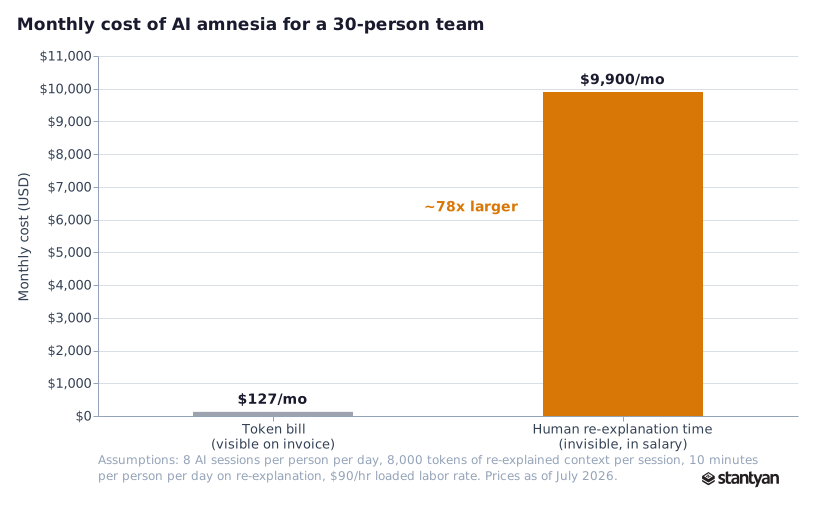
The monthly cost of AI amnesia for a 30-person team. The token bill is the small, visible slice. The invisible slice, the human time spent re-explaining context, is roughly 80x larger and lands in salary rather than on the AI invoice.
import altair as alt
import pandas as pd

# Assumptions for a 30-person team
people = 30
sessions_per_person_per_day = 8
tokens_resent_per_session = 8_000
working_days = 22
minutes_resent_per_person_per_day = 10
loaded_hourly_rate = 90  # USD, fully loaded

input_price_per_million = 3.00  # Claude Sonnet 4.6 base input rate, July 2026

# Token cost
monthly_tokens = people * sessions_per_person_per_day * tokens_resent_per_session * working_days
token_cost = (monthly_tokens / 1_000_000) * input_price_per_million

# Labor cost
monthly_minutes = people * minutes_resent_per_person_per_day * working_days
labor_cost = (monthly_minutes / 60) * loaded_hourly_rate

print(f"Token cost per month: ${token_cost:,.0f}")
print(f"Labor cost per month: ${labor_cost:,.0f}")
print(f"Labor-to-tokens ratio: {labor_cost / token_cost:.0f}x")

source = pd.DataFrame(
    {
        "category": ["Token bill|(visible on invoice)", "Human re-explanation time|(invisible, in salary)"],
        "cost": [token_cost, labor_cost],
        "label": [f"${token_cost:,.0f}/mo", f"${labor_cost:,.0f}/mo"],
    }
)
source["display"] = source["category"].str.replace("|", " ", regex=False)

base = alt.Chart(source).encode(
    x=alt.X(
        "category:N",
        sort=None,
        title=None,
        axis=alt.Axis(labelExpr="split(datum.label, '|')", labelAngle=0),
    )
)

bars = base.mark_bar(size=160).encode(
    y=alt.Y(
        "cost:Q",
        title="Monthly cost (USD)",
        axis=alt.Axis(format="$,.0f"),
        scale=alt.Scale(domain=[0, 11000]),
    ),
    color=alt.Color(
        "category:N",
        scale=alt.Scale(
            domain=["Token bill|(visible on invoice)", "Human re-explanation time|(invisible, in salary)"],
            range=["#9ca3af", "#d97706"],
        ),
        legend=None,
    ),
    tooltip=[
        alt.Tooltip("display:N", title="Cost"),
        alt.Tooltip("label:N", title="Monthly"),
    ],
)

labels = base.mark_text(dy=-12, fontSize=14, fontWeight=600, color="#1a1a2e").encode(
    y="cost:Q", text="label:N"
)

ratio_note = (
    alt.Chart(pd.DataFrame([{"note": f"~{labor_cost / token_cost:.0f}x larger"}]))
    .mark_text(fontSize=14, fontWeight=600, color="#d97706", align="right")
    .encode(
        x=alt.value(alt.expr("width * 0.60")),
        y=alt.value(alt.expr("height * 0.42")),
        text="note:N",
    )
)

assumptions = (
    alt.Chart(alt.InlineData(values=[{}]))
    .mark_text(
        text=[
            f"Assumptions: {sessions_per_person_per_day} AI sessions per person per day, {tokens_resent_per_session:,} tokens of re-explained context per session, {minutes_resent_per_person_per_day} minutes",
            f"per person per day on re-explanation, ${loaded_hourly_rate}/hr loaded labor rate. Prices as of July 2026.",
        ],
        align="left",
        fontSize=12,
        color="#94a3b8",
        lineHeight=16,
    )
    # left-anchored across the full chart bottom; the short second line ends
    # well clear of the bottom-right watermark corner
    .encode(x=alt.value(0), y=alt.value(alt.expr("height + 44")))
)

chart = (bars + labels + ratio_note + assumptions).properties(
    title="Monthly cost of AI amnesia for a 30-person team",
    padding={"left": 16, "top": 16, "right": 16, "bottom": 40},
)

chart.save("amnesia-cost-chart.svg")
That is one team. Scale it across an organization with 300 daily AI users and the same model puts the labor cost at $99,000 a month. This is the team productivity tax of AI amnesia, and it is still missing from almost every AI-agent ROI conversation.
What better agent memory would actually require
I hold every memory system I read about against 5 properties, and current approaches satisfy them partially at best:
- structured rather than stored: more than a bag of embedded text chunks - entities, relationships, events, something an agent can reason over instead of just retrieving similar strings
- temporally aware: every memory carries when it was created and the range over which it is valid, and retrieval respects both. A fact that was true last quarter and false this quarter should not come back dressed as current
- honest about confidence: retrieval returns a confidence signal, including the explicit option to return nothing at all. “I don’t have a memory of this” should be a first-class response, not a hallucination opportunity
- cheap enough to query on every turn: memory lookups need to run an order of magnitude cheaper than a model call, or the agent cannot afford to consult them continuously. Vector retrieval sits in roughly the right cost neighborhood, and structured queries should too
- portable across the models the agent uses: the agent stack changes faster than the memory representation should, and re-platforming memory every time a new flagship ships is not a viable architecture. Portability is the architectural decision nobody prices in until the switching bill arrives
You should also be able to read what such a system holds and correct it, because a memory nobody can inspect is just a liability with good recall. No vendor satisfies all five today, and the interesting work of the next two years belongs to the systems that try.
So what?
Before your next agent-stack procurement decision, run a one-week measurement. Pick three people on your team and have each one keep a tally of every meaningful AI session and how many minutes that session spent on context the person had already established somewhere. Multiply by headcount and 22 working days. That number is the baseline cost you are already paying for AI amnesia, and it is what the next memory layer your agents adopt will have to move.