AI
Portable AI Memory or Permanent Lock-In: The Architectural Choice That Will Define AI's Next Decade
AI memory is the new vendor lock-in. Open formats from one vendor are not enough - the category needs a neutral interchange standard, and regulation agrees.
Picture a team 18 months into Claude Projects. Hundreds of conversations, project instructions refined over dozens of iterations, an accumulated body of context about the codebase, the customers, the decisions already made and why. Then leadership asks a reasonable question: should we evaluate Gemini? Whoever owns the AI stack now has to give an uncomfortable answer, because the subscription is easy to cancel and the 18 months of accumulated context has no migration path at all. You can export conversations as JSON and memory as a text summary, and nothing on the other side can reconstruct what the tool actually knew about you. AI memory portability, as a practical capability, does not exist in July 2026, so the honest migration plan is starting over.
The oldest posts on this site went up in 2017. They are still readable in 2026 for one reason: the writing lived as plain markdown files, and the files outlasted everything around them - the current site was rebuilt from those files in March, after nothing else made it across: not the theme, not the generator, not the hosting setup. So I have collected the payout of portable plain files once already. An AI memory store is the same bet with no plain files at the bottom of it.
What changed this summer is that the first vendors noticed. One open-sourced its entire memory engine so customers can inspect and self-host what their agents know. Another stores memory as plain markdown with git semantics and markets itself as the portable memory layer. Both moves are real progress, both get full credit below, and both illustrate precisely what is still missing, because a format that only one product writes is a well-documented dialect.
The thesis is short and it carries a decade of consequences. Memory is the new vendor lock-in, memory portability is the architectural decision of the decade, and the category needs a neutral interchange standard that no single vendor owns. Nobody is building that standard yet. The rest of this piece argues why someone must, what it has to contain, and why the regulatory clock in Europe has already started.
The new lock-in is at the memory layer
The models themselves stopped being the switching cost somewhere in the last two years. Frontier models leapfrog each other every few months, the API shapes are near-identical, and swapping providers behind a decent abstraction layer is an afternoon of work. If that sounds overstated, June ran the experiment for all of us. On June 12, the US government issued an export control directive that forced Anthropic to pull its newest flagship models offline worldwide within hours. Teams that had adopted them fell back to older models within days and kept shipping. Access came back on July 1, nineteen days later, which means the most capable model on the market vanished for close to three weeks and the ecosystem absorbed it. Now try to imagine absorbing the overnight loss of everything your AI tools have learned about your team. That asymmetry is the whole argument.
So differentiation moved up the stack, and what a platform knows about you became the one asset a competitor cannot replicate by shipping a better model, which every major vendor understands perfectly well. The pattern I laid out in why AI agents forget by design - and where the captured context lives now has a second act: the same context that applications painstakingly rebuild on every stateless API call is now being captured, persistently, inside each platform’s own memory features. The capture is genuinely useful, and it is also, structurally, a moat.
The clearest current example arrived on June 23, when Anthropic launched Claude Tag: Claude as a persistent teammate inside Slack, with channel-scoped memory that accumulates as it works and can extend across an organization’s channels when granted permission. The product is impressive, and the memory lives bound to the Slack workspace and to Anthropic, with no documented export. Every week it runs, it learns more about how a company works, and every week the cost of ever using anything else grows. Nobody had to design that as a trap for it to function as one.
The economics here are old: databases, ERPs and cloud data warehouses all ran the same play, where the product is replaceable, the accumulated state is not, and the state is priced into the exit. What is new is the breadth of the capture. A data warehouse holds your tables, while an AI memory layer holds how your organization thinks: preferences, decisions, conventions, the reasoning behind choices, who said what and when. The switching cost stopped being your data and became your institutional knowledge, in a shape only one vendor can read.
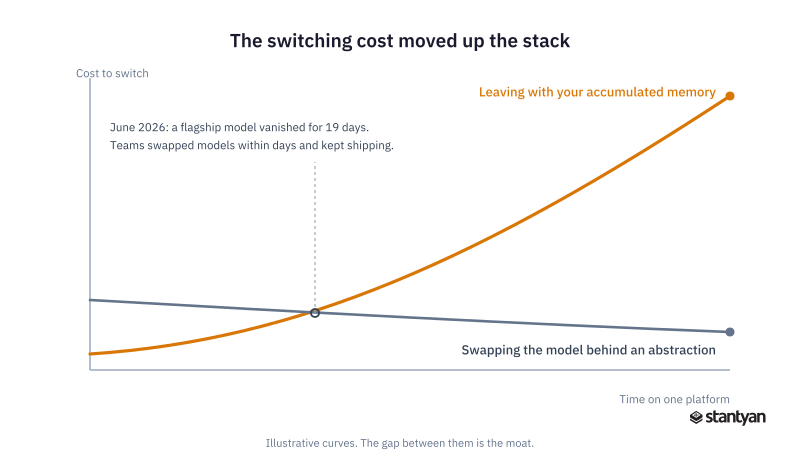
Model switching cost keeps falling - June 2026 proved a flagship can vanish for nineteen days while teams swap models within days and keep shipping. Memory switching cost compounds with every week on the platform. The widening gap between the two curves is the moat.
Three kinds of lock-in your AI memory creates
Not everything a platform remembers locks you in the same way: there are 3 layers, and they cost different amounts on the way out.
Behavioral lock-in is the learned layer: your preferences, your style, the corrections you have made a hundred times. ChatGPT’s Memory is the canonical consumer example, and also the canonical one-way door. OpenAI’s own Memory FAQ covers viewing, managing and deleting memories, and stops there, with no export. The account-level data export hands you your conversation history while the distilled memory the product actually uses to personalize responses stays inside, so what the system learned about you over a year of daily use is, by construction, not yours to take.
Context lock-in is the working-state layer: project history, established facts, decisions and their rationale, the running state of everything in flight. Teams feel this layer first when they evaluate a switch, because it is what makes the tool useful on Monday morning without a briefing. It is also where the industry’s one genuine interoperability precedent lives. Anthropic ships a memory import that accepts memories brought over from ChatGPT, Gemini or Grok, and Google answered with a ZIP-based import of its own. Credit where due, these are real doors between platforms, and they mattered enough to trigger a minor migration wave this spring. But look at the mechanism: the user runs a prompt that asks the old assistant to write out what it remembers, then pastes or uploads the prose into the new one. That is an on-ramp built by the vendor who benefits from the traffic, it flattens everything to text, and it moves in whichever direction the importing vendor built, which is not what a standard looks like.
Relationship lock-in is the layer almost nobody prices in, because it only exists in team settings: who established which fact, who decided what and when, whose correction superseded whose earlier claim. This is provenance, and provenance is what turns a pile of remembered facts into organizational memory you can trust and audit. It is also what shared, channel-scoped memory products accumulate fastest and expose least, because once memory becomes a teammate instead of a personal notebook, the who-said-what-when graph turns into the most valuable and least exportable thing in the building. Auditors and legal teams will eventually ask about this layer too, because a decision trail you cannot export is a decision trail you cannot produce on request.
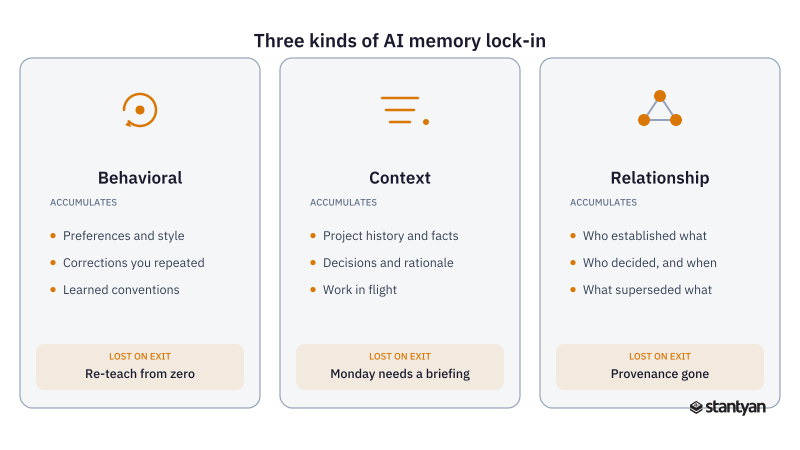
Three kinds of lock-in, three different exit costs. Behavioral memory is annoying to lose and context memory is expensive to lose. Relationship memory - the provenance graph of who established what - is the one an organization cannot rebuild from a plain-text export.
Each layer compounds on the one before it, and the compounding is the point: none of this is a bug a vendor will fix under competitive pressure, because the pressure runs the other way and retention economics reward capture. Only two forces push against it, customers who demand portability in procurement and regulators who mandate it.
The vendors who noticed (and why it’s not enough yet)
Two products shipped this year that take memory ownership seriously, and the honest version of this argument has to start by steelmanning them.
Cognee 1.0 launched on June 26 as a fully open-source memory engine: a typed knowledge graph you can run on a single Postgres instance, an API built around 4 verbs - remember, recall, improve, forget - and an export path to its own COGX archive format. The launch post is explicit about why, because teams were not going to hand the memory of their business to, in Cognee’s words, “a black box they couldn’t inspect, host themselves, or take with them.” That is the correct diagnosis, stated by a vendor, in public. Self-hosting means your memory sits in your own database, open source means you can read every line of the code that writes it, and if every memory product met this bar, half of this article would be unnecessary.
ByteRover attacks the same problem from the developer-tools side and calls itself the portable memory layer for coding agents. Its memory is a hierarchical context tree stored as plain markdown and versioned with git semantics: you commit memory changes, branch them, merge them, push and pull them between machines and teammates. Anyone who has watched a team lose a month of agent context to a laptop swap understands immediately why this is the right shape. The memory my own agents run on is markdown files in a git repository, so this is a design I recognize from my own setup, not a pitch I am evaluating cold. Files you can read in any editor, with history, that move the way code moves - as a design instinct about who should hold memory, it is exactly right.
Both vendors get full credit for moving first, and neither has solved portability, because a single implementation cannot. Open source makes a format inspectable, and inspectable is not the same thing as portable between vendors, because portability lives in the ecosystem rather than in any one codebase. A COGX archive is readable by Cognee, a ByteRover context tree is meaningful to ByteRover, and if either company disappeared tomorrow your memory would be legible, which is a real improvement over the incumbents, but still stranded, because nothing else writes or reads that shape natively. A format only one implementation writes is a dialect, not a standard. Neither vendor can rebut that without arguing against their own openness, which is exactly why it is the right test.
The demand signal extends beyond vendors. In the first half of 2026 alone, at least three independent interchange proposals appeared: MIF, an individual developer’s memory interchange spec, memorywire, an academic wire-format proposal for memory operations, and the community-driven Open Memory Protocol, which describes itself as vendor-neutral. Add COGX, a vendor’s own export format, and you have four different answers to the same question inside six months, and none of them has institutional governance, a second independent implementation or vendor adoption. I am not reviewing them here, and that is deliberate, because the wave matters more than any entry in it: when four unrelated parties independently invent the same missing piece, the piece is missing.
So the gap, stated precisely: no format has yet been placed under neutral governance and implemented, independently, twice. That gap has a well-known shape, and the industry has closed it before.
Why portability is harder than an export button
Every platform’s answer to portability criticism is the same: we have data export. And every one of those exports fails the same way, because an archive that preserves the text while discarding the structure has exported the words and deleted the knowledge. Real portability has 6 requirements, and the list below is what separates an export button from an exit.
- structure: memory is typed, a fact about a customer, a decision with its rationale, a preference, an event with participants. Flattening these into paragraphs of prose forces the importing system to re-extract the types with a model, which means guessing, which means loss, because the typed objects are the memory.
- attribution: every memory has an origin, the person who stated it, the document it came from, the agent that inferred it. Strip that and a team archive becomes a pile of unverifiable claims, keep it and you can still ask why the system believes something and on whose word.
- relationships: the edges between memories carry as much meaning as the memories themselves. This decision was made because of that constraint, this fact supersedes that earlier one, these five facts describe the same entity, and a prose dump destroys the edges first.
- temporal validity: every fact was learned at some time and stayed true for some interval, and “the user works at Aiven” versus “the user worked at Aiven until March 2025” are different memories, only one of them safe to retrieve today. An export that drops the time dimensions ships stale facts as current ones, at scale, into the importing system. This is the same two-clock problem that makes memory hard to build in the first place, and it is why the architecture underneath matters for what survives the export, because a store that never modeled validity intervals has nothing to preserve.
- permissions: shared memory is scoped, some of it channel-visible, some private to a person, some restricted to a group. An archive that discards scope converts a permission model into a data breach with a progress bar, and whoever imports it either over-shares or rebuilds the access rules by hand.
- provenance: how a memory came to be, asserted directly, inferred by a model, merged from three earlier records. Derived memories inherit the reliability of their sources, so an archive that cannot express derivation chains cannot support trust decisions on the other side.
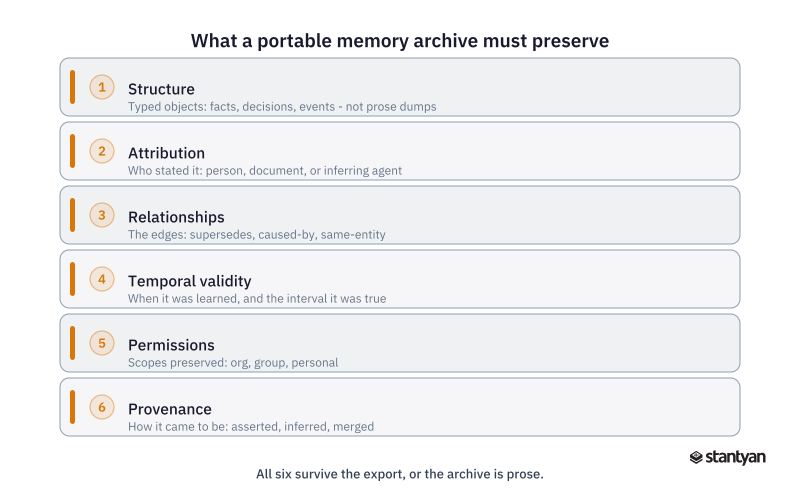
The 6 layers, in the order exports lose them. Most current export features drop all six, and the open-source engines keep the top three for their own reader only. An archive is only as portable as its weakest preserved layer.
Hold current products against those requirements and most exports satisfy none of them, while even the best satisfy them for one reader only. Which brings in the test that actually decides the question, call it import symmetry: an export only counts as portable if a competing product can read it back and reconstruct the memory, the objects, the edges, the timestamps, the scopes, rather than just the text. Symmetry is what separates a door from a mail slot. I checked every claim in the table below against vendor documentation and product behavior in the first week of July 2026, including Cursor’s rules and memories, because this is exactly the kind of table that gets screenshotted and fact-checked.
| Product | Export format | Structure | Attribution | Relationships | Re-importable by a competitor |
|---|---|---|---|---|---|
| ChatGPT Memory | Account ZIP covers conversations - saved memories have no export | No | Conversations only | No | No - rivals scrape it via prompt |
| Claude Projects and memory | Account ZIP (JSON) - memory exports as a text summary | Partial | Partial | No | No - imports in, no structured out |
| Claude Tag channel memory | None documented | No | No | No | No - workspace-bound |
| Gemini saved info | Takeout covers activity - saved info not separately exportable | No | Partial | No | No - accepts rival ZIPs in, flattened to text |
| Cursor rules and memories | Rules are markdown in-repo - memories have no export | Partial (rules only) | No | No | Rules copy trivially - memories no |
| Cognee | Self-hosted graph in Postgres - vendor COGX export | Yes | Yes | Yes | No - single implementation |
| ByteRover | Markdown context tree with git history | Partial | Yes (commit metadata) | Yes | No - single implementation |
Read the last column top to bottom: seven products, seven variations of no. The two open-source entries preserve dramatically more than the incumbents, structure, attribution and relationships all survive, and they still fail symmetry, because symmetry cannot be shipped unilaterally. It requires a format that at least two independent implementations write and read, which is a standards problem, not a product feature.
The format should be open even when the platform isn’t
Here is the split that makes this argument workable for commercial vendors instead of a demand that everyone open-source their product: the platform can stay proprietary. The retrieval engine, the ranking models, the integrations, the UX, compete on all of it and keep all of it closed. The customer’s archive of their own memory is the one part that must not be proprietary, because what a company’s people taught the system belongs to the company, and belonging means holding it in a form that survives the vendor.
The archive format has its own bar to clear: 6 properties, separate from the 6 layers it preserves. Openly documented, so anyone can write a parser without reverse engineering, and permissively licensed, so implementing it requires nobody’s permission. Readable with standard tooling, so a customer can inspect their own archive tomorrow without the platform, and verifiable, so checksums and record counts let a third party confirm the export is complete and untampered. Implementation-plural, meaning at least two independent codebases write and read it, and vendor-surviving, meaning the spec lives somewhere that outlasts any company that contributed to it.
The container industry already ran this exact play. In June 2015, Docker took the two things that made containers Docker-shaped, its image format and its runc runtime, and donated them to a newly formed Open Container Initiative under the Linux Foundation. The part of that history people tend to misremember is where the virtue sits. Docker did not stop being a company and did not open-source its platform, and the move that deserves the credit is narrower and harder than code openness: it gave up unilateral control of the format. That is what turned “runs on Docker” into “runs anywhere”. containerd, CRI-O and Podman followed as independent implementations, and portability became the category’s default property rather than one vendor’s promise. WebAssembly repeated the pattern for compute, a W3C standard with multiple competing engines, which is exactly why nobody worries about their .wasm binaries being stranded. So the lesson assigns the virtue correctly: publishing a candidate spec and offering it to neutral governance is the first move that counts, the one Docker made, and the failure mode is keeping the format captive. The current memory market is all candidates and no donations.
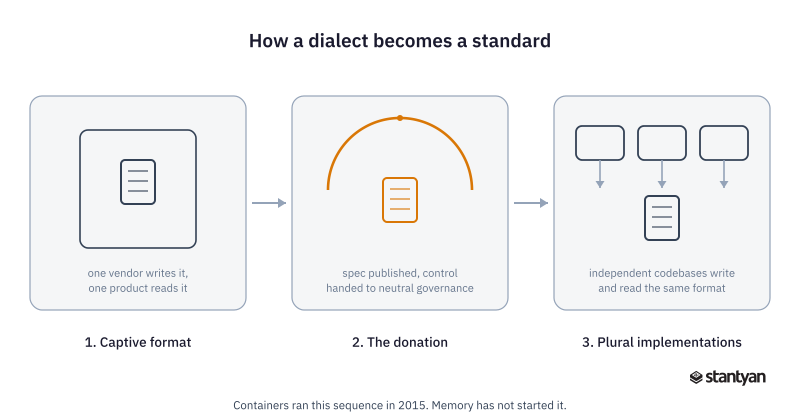
The sequence that turns a dialect into a standard: a captive format, then the donation to neutral governance, then plural implementations. Stage two is the move no memory vendor has made yet. Everything before it is a well-documented dialect and everything after it is portability.
What would the neutral archive contain? Not any existing product’s schema, since the point of a standard is that it is nobody’s internal format. But the shape of the manifest is easy to sketch, something a procurement team, an auditor or a competing importer could open and understand in one screen:
{
  "format": {
    "spec": "https://example.org/memory-archive/spec",
    "version": "1.0",
    "license": "CC-BY-4.0"
  },
  "created_at": "2026-07-14T06:00:00Z",
  "exported_by": "vendor-platform-name/4.2.1",
  "source_platforms": ["vendor-platform-name"],
  "coverage": {
    "from": "2025-01-08",
    "to": "2026-07-13"
  },
  "records": {
    "facts": 18432,
    "decisions": 921,
    "relationships": 44210,
    "participants": 63
  },
  "scopes": ["org", "team:data", "personal"],
  "integrity": {
    "algorithm": "sha256",
    "archive_checksum": "9f2c4a...e81b",
    "per_file_manifest": "checksums.txt"
  }
}
Everything in that sketch serves the exit scenario. Record counts let you verify nothing was silently dropped, the date range tells you what period you hold, and scopes tell the importer which permission boundaries to reconstruct before anything is shared. The checksum block means a third party can attest completeness without trusting either vendor, and verification is genuinely trivial, ten lines of Python, no SDK, no API key, no platform:
import hashlib, json, sys

manifest = json.load(open("manifest.json"))
digest = hashlib.sha256(open(sys.argv[1], "rb").read()).hexdigest()

claimed = manifest["integrity"]["archive_checksum"]
total = sum(manifest["records"].values())
print(f"records claimed: {total:,}")
print(f"checksum match: {digest == claimed}")
# -> records claimed: 63,626
# -> checksum match: True
That a customer can run those ten lines against their own memory, on their own machine, with the vendor’s servers switched off, is the entire meaning of ownership. Every requirement in this section is boring, established engineering, none of it is a research problem, and the hard part is getting competing vendors to agree on one format.
Protocol portability is the other half
An archive format solves the divorce and does nothing for the marriage. Batch export is what you reach for when leaving, while what prevents lock-in from accumulating in the first place is the ability to run more than one tool against the same memory while you stay. That requires the second half of the standard, a read/write protocol, so that an agent, an IDE and a chat interface from three different vendors can consult and update one memory store the way three different mail clients speak IMAP to one inbox.
The protocol requirements are as unexotic as the archive’s. Transport-agnostic, so it works over plain HTTP without vendor SDKs, and standard authorization, meaning OAuth instead of bespoke key schemes, because enterprises govern access with the machinery they already run. Discoverable, so a client can ask a memory server what scopes and capabilities it offers. And versioned, with a real deprecation policy, so implementations written this year still interoperate in three.
There is an obvious precedent for standardizing exactly this kind of seam, and it is instructive both for what it did and for what it has not done. The Model Context Protocol took the tool-access seam, how models call external capabilities, and turned it from N-times-M custom integrations into one contract, governed today under a foundation rather than a single company. Its 2026-07-28 release candidate formalizes an Extensions framework, independently versioned and separately maintained additions to the core spec, which is structurally the natural home for a memory interface. And the 2026 roadmap does not mention memory at all. Its priorities are transport, agent communication, governance and enterprise readiness, and no memory extension has been proposed through the project’s enhancement process, let alone shipped. I read that absence as opportunity rather than indifference: the rails for a neutral memory protocol now exist, formally, with governance attached, and nobody has put a train on them.
So the full standard is 2 documents, an archive format for the memory you take when you leave, and a wire protocol for the memory you share while you stay. Either alone leaves half the lock-in intact, because a protocol without an archive means your memory is interoperable right up until the vendor hosting it changes terms, and an archive without a protocol means you own a snapshot while the living state stays captive. Together they change the default posture of the whole stack: tools become clients of your memory rather than owners of it, and adding or dropping a tool stops being a data event at all.
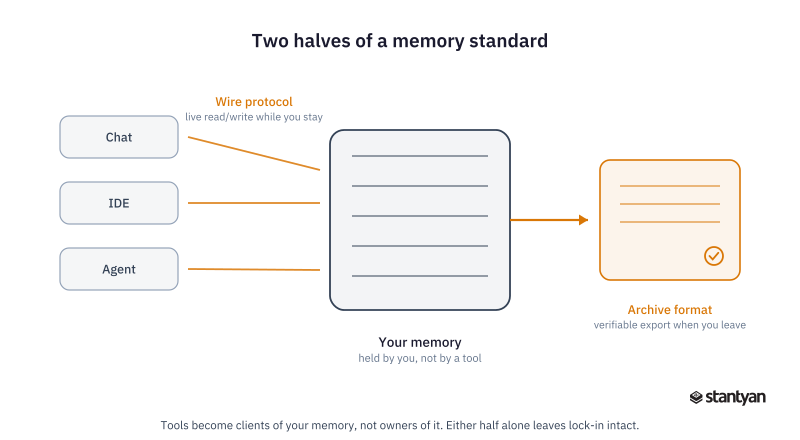
The two halves of the standard. The wire protocol prevents lock-in from accumulating while you stay, and the archive format makes leaving lossless. Either half alone leaves the other door locked.
The regulatory case (which is already settled)
The strongest objection deserves to go first, because it is a good one. In March 2026, the Court of Rome annulled the Italian regulator’s fine against OpenAI, the most prominent GDPR enforcement action yet taken against a generative AI provider, so anyone claiming that European courts reliably punish AI companies over data rights is ahead of the evidence. Court enforcement is contested, the statutory obligations are not, and the distinction matters, because compliance programs and procurement requirements are built on what the law says, not on which fines survive appeal.
And what the law says is unusually on-point. Article 20 of the GDPR gives every person the right to receive the personal data they provided to a controller “in a structured, commonly used and machine-readable format” and to transmit it to another controller without hindrance. Where technically feasible, that includes direct controller-to-controller transmission. Hold that against the export table above: a text summary of what an AI remembers about a person is a weak answer to structured and machine-readable, and no export at all, the current state of the largest consumer memory feature, is not an answer. Article 17 adds the right to erasure, which carries a quieter architectural implication, because you cannot credibly erase what you cannot enumerate. A memory system that cannot produce a complete, structured account of what it holds about a person cannot demonstrate deletion either. Portability and erasure are the same engineering problem wearing two legal hats.
The enforcement side is switching on rather than standing still. Under the EU AI Act, the Commission’s enforcement powers over general-purpose AI providers activate on August 2, 2026, nineteen days after this piece goes live, ending the one-year grace period since the underlying obligations took effect. Penalties for GPAI violations reach 15 million euros or 3 percent of global turnover. European regulators have also been explicit that AI memory sits inside existing data protection law, and the EDPB’s Opinion 28/2024 works through how GDPR applies to AI models processing personal data, which is what every memory feature in the table does for a living. Nor is the clock only European. California’s CCPA grants access to personal information in a readily useable format plus deletion rights, and roughly twenty US states now run comprehensive privacy statutes with portability provisions. Every one of them was written broadly enough to cover a vendor’s memory store about a person.
I live in Helsinki, where the European statutes above are the local law. For any vendor selling memory to organizations with European employees or customers, structured export stopped being a differentiator to schedule for some future quarter and became a compliance surface with an enforcement authority attached and a start date on the calendar. The vendors treating portability as a nice-to-have are accumulating a liability they have not priced.
The economic case
For buyers, the numbers on what lock-in already costs are in, and they are stark. Zapier’s 2026 enterprise survey on AI vendor lock-in, 542 US executives with paid AI contracts, found 81 percent concerned about dependency on specific AI vendors and only 6 percent saying they could drop their primary vendor without disruption. The gap between belief and experience is the striking part: 89 percent think they could switch providers within a month, while 58 percent of attempted migrations failed outright or took far more effort than expected. That gap lives at the memory layer, because endpoints swap in a sprint and accumulated context is what makes the confident one-month estimate wrong.
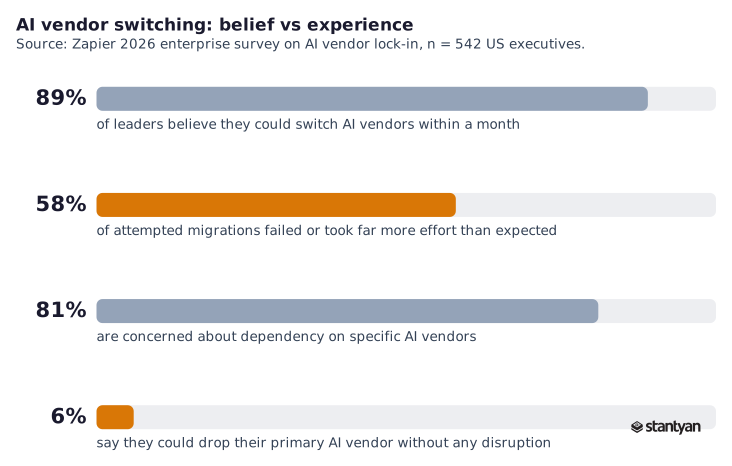
The confidence gap, measured. Nine in ten leaders believe a vendor switch takes a month, while a majority of teams that actually tried found the migration failed or ran far over. Only 6 percent can leave their primary vendor cleanly, which is another way of saying the memory layer has already locked.
import altair as alt
import pandas as pd

# Zapier 2026 enterprise survey on AI vendor lock-in, n = 542 US executives.
# The gap between the belief rows (gray) and the experience rows (amber) is
# the argument: confidence about switching is not experience of switching.
source = pd.DataFrame(
    [
        {"id": "a", "share": 89, "kind": "belief", "text": "of leaders believe they could switch AI vendors within a month"},
        {"id": "b", "share": 58, "kind": "experience", "text": "of attempted migrations failed or took far more effort than expected"},
        {"id": "c", "share": 81, "kind": "belief", "text": "are concerned about dependency on specific AI vendors"},
        {"id": "d", "share": 6, "kind": "experience", "text": "say they could drop their primary AI vendor without any disruption"},
    ]
)
source["numeral"] = source["share"].map("{}%".format)

y = alt.Y("id:N", sort=None, title=None, axis=None, scale=alt.Scale(paddingInner=0.62, paddingOuter=0.1))
x = alt.X("share:Q", scale=alt.Scale(domain=[-13, 100]), axis=None)

tracks = alt.Chart(source.assign(full=100)).mark_bar(height=24, cornerRadius=6, color="#64748b", opacity=0.12).encode(
    y=y, x=alt.X("zero:Q", scale=alt.Scale(domain=[-13, 100]), axis=None), x2="full:Q"
).transform_calculate(zero="0")

bars = alt.Chart(source).mark_bar(height=24, cornerRadius=6).encode(
    y=y,
    x=alt.X("zero:Q", scale=alt.Scale(domain=[-13, 100]), axis=None),
    x2="share:Q",
    color=alt.Color(
        "kind:N",
        scale=alt.Scale(domain=["belief", "experience"], range=["#94a3b8", "#d97706"]),
        legend=None,
    ),
).transform_calculate(zero="0")

numerals = alt.Chart(source).mark_text(align="right", dx=-10, fontSize=21, fontWeight=600, color="#1a1a2e").encode(
    y=y, x=alt.value(alt.expr("13 / 113 * width")), text="numeral:N"
)

descriptions = alt.Chart(source).mark_text(align="left", dy=26, fontSize=13.5, color="#334155").encode(
    y=y, x=alt.X("zero:Q", scale=alt.Scale(domain=[-13, 100])), text="text:N"
).transform_calculate(zero="0")

chart = alt.layer(tracks, bars, numerals, descriptions).properties(
    title=alt.TitleParams(
        text="AI vendor switching: belief vs experience",
        subtitle="Source: Zapier 2026 enterprise survey on AI vendor lock-in, n = 542 US executives.",
    )
)

chart.save("belief-vs-experience-switching.svg")
For vendors, the honest framing is a trade. Captive memory is a moat, and moats are valuable. This particular moat appreciates as a liability at the same rate it appreciates as an asset, because every month of accumulated, non-exportable memory deepens the switching cost and the statutory exposure while making the eventual forced-export retrofit more expensive. The reputational price compounds too: sophisticated buyers have learned to read “no export” as “we plan to charge you for leaving”, and procurement teams increasingly ask the exit question before signing, not after. Meanwhile the drag of memory that cannot move runs in the background of every tool change, every reorganization and every vendor evaluation that dies at the migration estimate, and the productivity tax compounds when you can’t switch tools, because the re-explanation cost of starting over gets paid by every person on the team, every time.
Exportability inverts the trade, because a vendor with a documented, verifiable archive turns the enterprise trust conversation from adversarial to trivial: here is your memory, here is the spec, here is the checksum, leave whenever you want. Confidence that you can leave is what makes committing rational, and the counterintuitive economics of portability, the ones OCI proved for containers, are that lowering the exit cost raises the entry rate.
What the next decade looks like
Two paths fork from here, and the fork is being taken now, by default, in this year’s product roadmaps and procurement decisions, mostly without anyone naming it.
On the proprietary path, each platform’s memory is a silo, switching costs quietly become the business model, and the moats work for a while. Organizations wake up in 2029 with five years of institutional knowledge distributed across three vendors’ opaque stores, none of it consolidatable, all of it hostage to renewal negotiations. Regulators, armed with the statutes above and mounting complaints, start treating memory stores the way they treated closed banking data before open banking, as infrastructure too important to stay captive. The vendors on this path accumulate regulatory exposure faster than they accumulate moat, and the correction, when it comes, is imposed rather than designed.
On the portable path, memory outlives models and vendors both. Your organization’s accumulated knowledge sits in a documented format you hold, served over a standard protocol. The tools competing for your subscription then compete on what they do with that memory, retrieval quality, reasoning, knowing when not to answer, integrations, rather than on holding it hostage. Models keep commoditizing, tools keep churning, and none of it threatens the asset, because the asset is readable, verifiable and elsewhere, the only sense of yours that survives contact with a vendor’s worst quarter. June’s nineteen-day disappearance of a frontier model previewed this decade’s texture, models will vanish, get banned, get deprecated, get leapfrogged, and memory should be the layer of the stack that cannot.
Getting to the second path needs exactly one thing that does not currently exist: a candidate standard on the table under neutral governance, donated, not parked in one more repository its author controls. The venue already exists, because MCP now lives under the Linux Foundation’s Agentic AI Foundation alongside the extension machinery a memory interface would slot into. The move history rewards is Docker’s move: publish the spec, hand over control, let competitors implement it, and win on the product instead of the format. The first memory vendor to do this sets the terms of the standard everyone else will have to meet. The window for being first is measured in months, and it is the rare strategic decision that is also, simply, the right thing to build.
Three signals will tell you which path is winning, and all three are checkable from the outside. Watch for a vendor donating a memory format to neutral governance instead of publishing one more repository it controls. Watch for a memory extension entering the Model Context Protocol’s enhancement process, because that is where a wire protocol would surface first. And watch for the first regulator or major RFP to name structured memory export explicitly, which converts this argument from strategy into requirement. Any one of these moves the decade, and until one happens, every month is a month of memory accumulating on the wrong side of the wall.
So what?
Add one question to every AI memory procurement conversation, and put it in the RFP verbatim: “Can I export my entire workspace - every memory, relationship, attribution, and temporal annotation - as a documented open format I can read with standard tooling tomorrow, without your platform? And can a competing product write it back?” The second sentence is the import symmetry test, the one that single-vendor open formats fail. Any answer other than two yeses is a switching cost you are agreeing to pay later, and it compounds from the day you sign.