Product Analytics
Subscription Metrics That Actually Drive Decisions
A practitioner's reference to the subscription metrics that connect recurring revenue, retention, LTV, and unit economics into a system you can act on.

The subscription business model
Every subscription business is a leaky bucket. Users create accounts, some start free trials, a fraction convert to paying subscribers, and then - month after month, year after year - some of those subscribers leak out through cancellations and failed payments. The entire metric system exists to measure how fast water goes in, how much of it stays, and what each drop is worth.
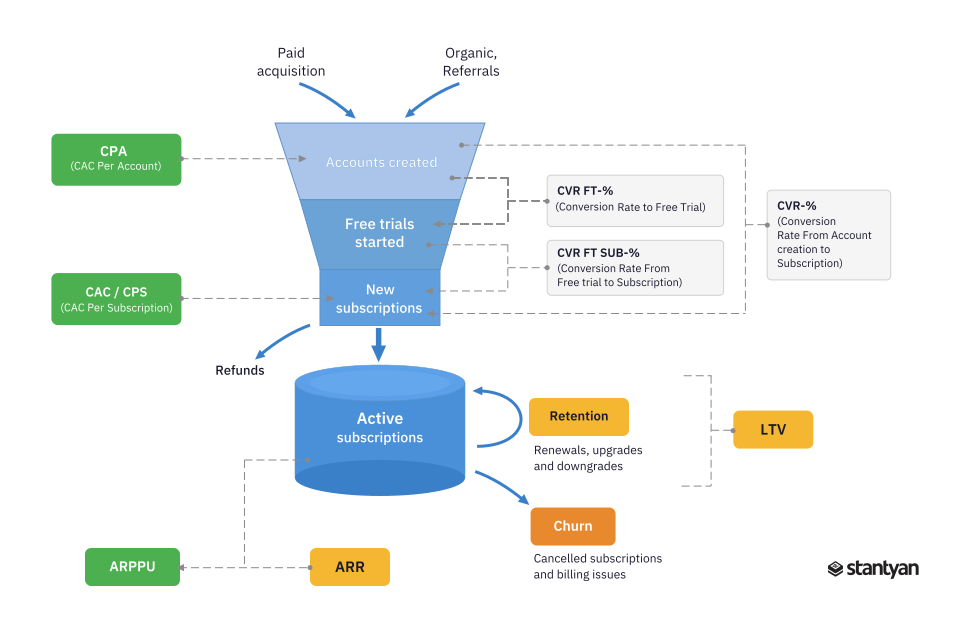
The subscription funnel. Every metric in this article connects to a stage in this system - from the cost of filling the top to the lifetime value of what stays at the bottom.
That sounds obvious, but most teams I have worked with track these metrics in isolation. They optimize conversion rate without understanding how it connects to LTV. They celebrate ARR growth without checking whether the quick ratio is healthy. The metrics only work when you treat them as parts of one machine.
This article walks through the full system: recurring revenue, monetization, retention, lifetime value, and acquisition economics. Each section covers what the metric measures, how to calculate it correctly, and - most importantly - what decisions it should actually inform.
Recurring revenue and active subscriptions
The financial value of a subscriber base is the single most critical number in a subscription business. It represents the “water in the bucket” - how much predictable revenue your current customers generate. Everything else - valuation, growth rate, acquisition budget - flows from this number.
The standard metric is Annual Recurring Revenue (ARR), sometimes called Annual Run Rate. ARR tells you how much revenue the current subscriber base would generate over one year, assuming no new subscribers join and none leave. It includes only subscription revenue - one-time purchases, setup fees, and professional services are excluded.
ARR links directly to company valuation. In SaaS and subscription businesses, valuation is often expressed as a multiple of ARR.
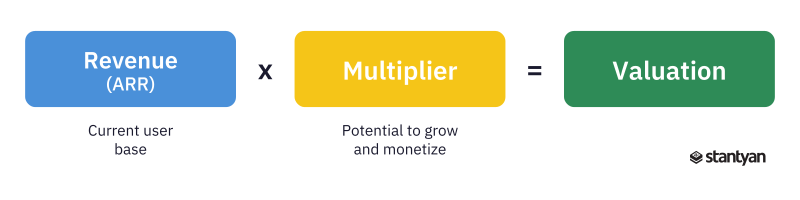
SaaS valuations are typically expressed as ARR times a multiplier. The multiplier captures growth rate, retention quality, market size, and margin profile.
The multiplier itself depends on growth trajectory, retention rates, market opportunity, and margin structure - but the starting point is always ARR. A business with $5M in ARR and strong unit economics will command a meaningfully different valuation than one with the same ARR but high churn and negative margins.
One detail that trips people up: ARR is calculated on revenue after indirect taxes (VAT, GST, sales tax). The ARR value of a subscription can be lower than the sticker price a customer sees. A $20/month subscription in a country with 20% VAT contributes $20 / 1.20 = $16.67 in monthly gross bookings, which annualizes to $200 in ARR - not $240.
To understand the dynamics behind aggregate ARR, break it into components:
| Component | What it measures |
|---|---|
| New ARR | Additional ARR from newly acquired subscribers in the period |
| Churned ARR | ARR lost from cancellations and billing failures |
| Expansion ARR | Additional ARR from existing subscribers upgrading plans |
| Contraction ARR | ARR lost from existing subscribers downgrading |
Net New ARR = New ARR + Expansion ARR - Churned ARR - Contraction ARR. When this number is positive, the bucket fills faster than it leaks.
Another way to express the subscriber base size is simply counting active subscriptions. ARR and active subscriptions are related through ARPPU:
ARR = Active Subscriptions x ARPPU But active subscription count alone is less useful for comparing businesses with different pricing structures. A business with 10,000 subscribers at $10/month looks very different from one with 1,000 subscribers at $100/month, even though both have the same subscriber count or ARR ballpark.
Monthly Recurring Revenue (MRR)
If your business runs primarily on monthly billing, MRR is the more natural metric. It is the same concept - predictable subscription revenue normalized to a time period - just measured monthly instead of annually.
ARR = MRR x 12 For businesses with a mix of monthly and annual plans, pick whichever metric matches your dominant billing cycle, but always be able to convert between them. Investors in early-stage SaaS typically want to see MRR; later-stage and enterprise-focused businesses tend to report ARR.
The SaaS Quick Ratio
The Quick Ratio measures growth efficiency - how much new revenue you generate for every dollar you lose.
Quick Ratio = (New MRR + Expansion MRR) / (Churned MRR + Contraction MRR) A ratio of 1.0 means the business is treading water: every dollar gained is offset by a dollar lost. A ratio above 4.0 signals very efficient growth. Between 1.0 and 4.0 is where most growing businesses land, and the ratio helps diagnose whether growth is coming from strong acquisition, strong retention, or both.
The simplified version:
New ARR / Churned ARR works if you don’t have meaningful expansion or contraction revenue yet, but the full formula is what you want for any business with plan tiers.
Net Revenue Retention (NRR)
Net Revenue Retention measures how much revenue you retain from your existing customer base over a period, including the effects of expansion, contraction, and churn - but excluding new customer acquisition entirely.
NRR = (Starting MRR + Expansion - Contraction - Churn) / Starting MRR x 100% NRR above 100% means your existing customers are worth more this period than last period, even without adding anyone new. That is an extremely powerful signal: the business grows from its installed base alone.
Public SaaS companies with NRR above 120% tend to command significantly higher valuation multiples than those below 100%. If you track only one metric from this section, make it NRR - it tells you whether the bucket is self-sealing.
Calculating recurring revenue in practice
The cleanest way to calculate actual ARR is from cumulative historical gross bookings - the real payments that hit your account.
For yearly plans, sum all gross bookings from the previous full year (new subscriptions and renewals). Every subscription paid within the last 12 months is still active and belongs to ARR. For monthly plans, take gross bookings from the previous full month and multiply by 12. For weekly plans, multiply the previous week’s bookings by 52. Total ARR is the sum across all plan types.
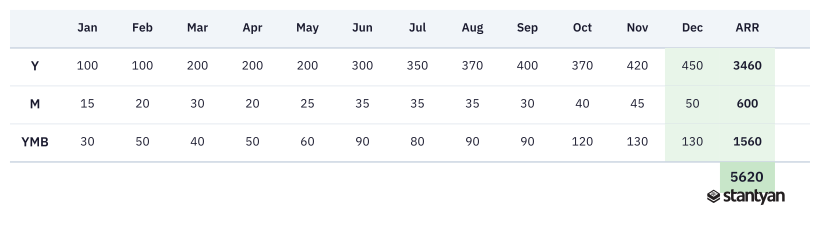
Calculating ARR from real bookings data. Each plan type’s bookings are normalized to an annual figure, then summed. This approach counts only successfully charged subscriptions - revenue that resulted in actual cash flow.
This method has a key advantage: it includes only successfully charged subscriptions. When you pull revenue data from payment platforms, you know it represents real incoming cash flow - no assumptions about whether a subscription will actually renew.
From the ARR components, you can derive additional metrics:
New ARR - calculated the same way but counting only first-time subscriptions, not renewals.
Retained ARR = ARR - New ARR Churned ARR = Previous Period ARR - Retained ARR Revenue Retention % = Retained ARR / To-be-renewed ARR Revenue Churn % = Churned ARR / To-be-renewed ARR Monetization
Monetization metrics answer the question: how much revenue does each subscriber generate, and how effectively are you converting free users into paying ones? The two core metrics here are conversion rate and ARPPU.
Conversion metrics
Conversion rates measure funnel efficiency - how many users who enter the top of the funnel eventually become paying subscribers. There are several ways to slice this depending on your funnel structure.
CVR % = New subscriptions / Accounts created If your funnel includes a free trial step, you can decompose this further:
CVR FT % = Free trials started / Accounts created CVR FT SUB % = New subscriptions / Free trials started The product of these two rates equals the overall conversion rate. When overall conversion drops, decomposing it tells you whether fewer people are trying the product (trial start problem) or fewer trialists are converting (value demonstration problem). Very different problems with very different solutions.
When counting new subscriptions for conversion metrics, deduct refunds within your refund window. A subscription that gets refunded within 7 or 14 days was never really a conversion.
Conversion windows matter. You need to define how long after account creation you count a subscription as a “conversion.” Common windows are 7-21 days from signup to trial start, and 14-30 days from trial start to subscription. Without defined windows, your conversion rates become meaningless - a user who signs up in January and subscribes in September inflates January’s conversion rate in a way that doesn’t reflect your current funnel performance.
ARPPU - Average Revenue Per Paying User
ARPPU is the average revenue generated per subscription payment in a given period. It sounds simple, but ARPPU is where many teams get the math wrong - and the consequences flow through to LTV and acquisition budget calculations.
The first important distinction: a global average ARPPU is rarely useful. The value varies dramatically by plan type, market, payment channel, and billing frequency. A yearly subscriber paying $120 up front and a monthly subscriber paying $15/month generate very different ARPPU figures. Report ARPPU segmented, or at minimum understand what is going into the average.
The second important distinction: gross versus net ARPPU.
Gross ARPPU is based on gross bookings - the customer price minus indirect taxes. This is not the sticker price. If a customer pays $20 and the local tax rate is 10%, gross bookings are $20 / 1.10 = $18.18.
Gross ARPPU = Total gross bookings / Number of subscription payments Net ARPPU goes further, removing payment channel fees (app store commissions, payment processor fees) from the gross figure. App store commissions can be 15-30% depending on the platform and revenue tier. Card payment processing fees are typically 2-3%.
Net ARPPU = Total net sales / Number of subscription payments 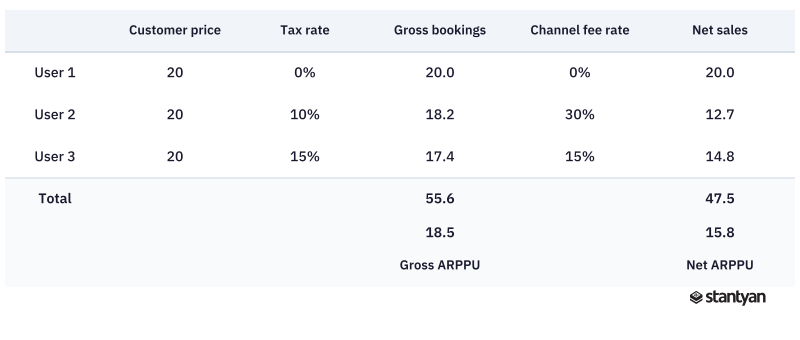
Same sticker price, different actual revenue. Tax rates and channel fees can reduce the money that reaches the business by 20% or more.
This distinction matters because it determines which LTV you calculate downstream. Gross ARPPU feeds Gross LTV - the total reported revenue a customer generates. Net ARPPU feeds Net LTV - the revenue after direct costs of sale, which is what you actually use to set acquisition budgets. Using gross LTV to set CAC targets will overstate how much you can afford to spend.
Sales value and transaction counts in the ARPPU calculation need to come from matching transactions. You cannot divide this month’s revenue by last month’s subscriber count and call it ARPPU.
ARPPU should be tracked over a timeline long enough to capture meaningful shifts. Exchange rate fluctuations, plan mix changes, promotional campaigns, and pricing experiments all affect ARPPU. Monitoring ARPPU over time reveals whether pricing changes are actually moving the needle.
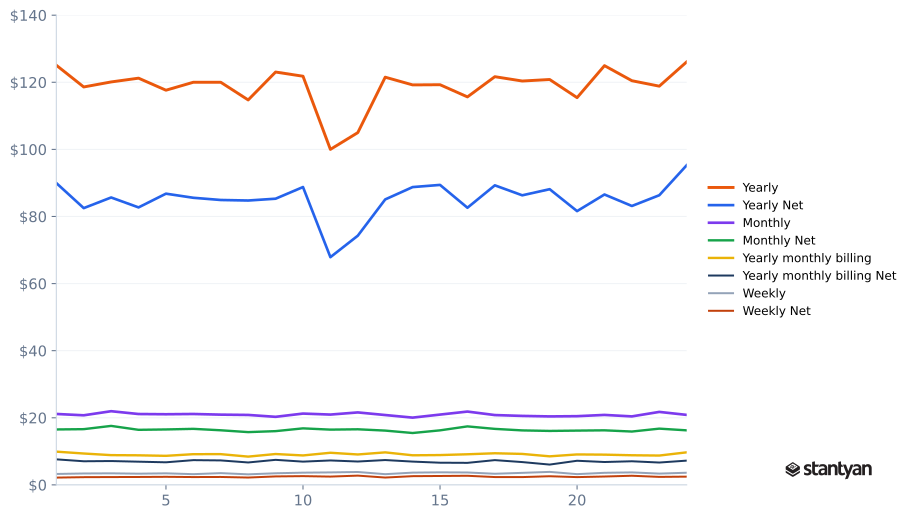
ARPPU by plan type over time. Yearly plans show the most volatility because individual pricing experiments and promotional campaigns have outsized impact on the average. The gap between gross and net lines is the cost of distribution.
ARPU vs. ARPPU
Average Revenue Per User (ARPU) includes all users in the denominator - including those on free plans or who never subscribed. It is sometimes called “blended ARPPU.” ARPU gives a rough sense of how well you monetize the overall user base, but it conflates conversion rate and per-subscriber revenue into a single number. For optimizing your business model, keeping conversion and ARPPU separate gives you much clearer levers to pull.
Subscriber retention
Subscriber retention is where the subscription model lives or dies. It measures the proportion of customers who renew their subscription when the renewal point arrives. Churn is the inverse: the proportion who leave.
Churn % = 1 - Retention % There is a direct line from retention to company valuation: better retention means higher LTV, which means you can afford to spend more on acquisition, which enables faster revenue growth from new subscriptions. And retention also means the existing base keeps generating revenue without additional acquisition spend. Both effects compound.
Put bluntly: you cannot grow recurring revenue indefinitely by acquiring new customers alone (unless you keep expanding the addressable market with new products or geographies). Monetizing existing subscribers is critical for sustainable growth. The math always catches up with leaky buckets.
A note on terminology. “Retention” in subscription businesses can mean two different things: user retention (how many active users keep engaging with the product) and subscriber retention (how many paying subscribers renew). These are correlated - high engagement usually predicts renewal - but they measure different things. This article focuses on subscriber retention unless stated otherwise.
Voluntary vs. involuntary churn
Subscribers churn through two different mechanisms, and the distinction matters because the fixes are completely different.
Voluntary churn happens when a subscriber actively cancels - or requests a refund after renewal. This is a product, value, or pricing problem.
Involuntary churn happens when the billing system fails to collect payment - expired cards, insufficient funds, payment processor errors. This is an infrastructure problem, addressable with retry logic, card update prompts, and dunning campaigns.
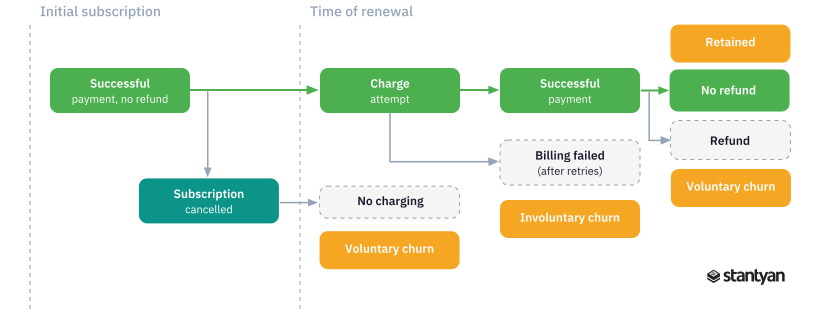
The subscription lifecycle. A subscriber can exit through voluntary cancellation, refund after renewal, or involuntary billing failure. Each exit path requires a different intervention.
Many businesses lose 2-5% of their subscriber base per month to involuntary churn alone. Fixing payment infrastructure - smarter retry schedules, pre-dunning notifications, card updater services - is often the highest-ROI retention investment a team can make.
The retention profile
Retention is not a single number. It is a curve.
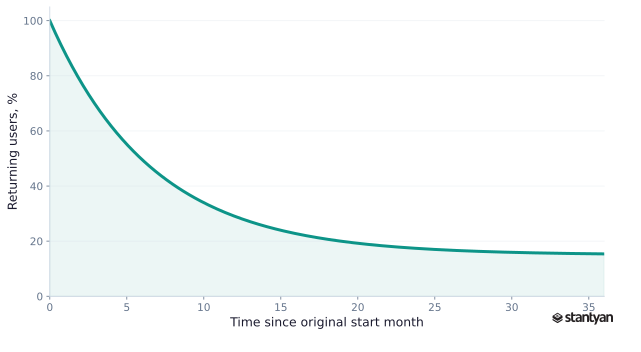
The typical subscription retention profile. Early months see the steepest churn; survivors are increasingly likely to stay. This curve shape is nearly universal across subscription businesses.
This shape is typical: churn is steepest in the first few periods after subscription, then gradually flattens. Subscribers who survive the first renewal are much less likely to churn in subsequent periods. This has two important implications.
First, measuring average churn across the entire subscriber base is misleading. A subscriber in month 2 has very different churn probability than one in month 18. The average blends these together into a number that describes nobody.
Second, where on the curve you focus improvement efforts matters. The total customer lifetime across a cohort is the area under the retention curve. Shifting the entire curve upward (through fundamental product improvement) has the largest impact. But when targeting a specific part of the curve, early-stage retention improvements compound more than late-stage ones, because every survivor flows through all subsequent periods.
Calculating subscriber retention
Subscriber retention compares renewed subscriptions against to-be-renewed subscriptions (subscriptions that reached their renewal date and needed to renew).
Retention % = Renewed subscriptions / To-be-renewed subscriptions The “to-be-renewed” denominator is important. You are not dividing by all active subscribers - only those whose subscription period actually ended and required a renewal decision.
To track retention over time and across cohorts, calculate it by original subscription start month. For example, Year 1 retention for subscribers who started in January measures how many of those January starters still have an active subscription one year later. Associating retention with the original start month lets you correlate retention changes with product changes, pricing experiments, or market shifts.
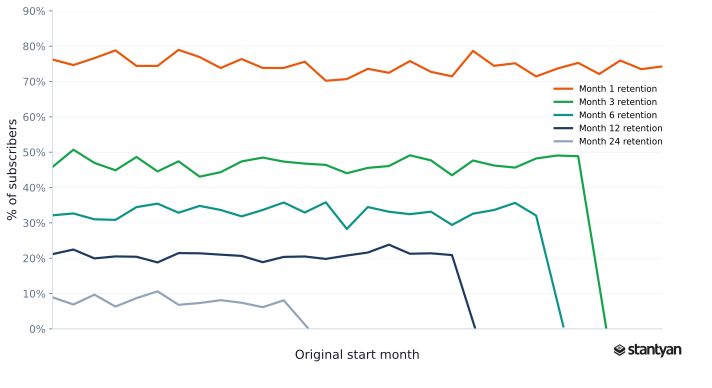
A retention portfolio for monthly plans. Each line tracks a different retention milestone across cohorts. Stability indicates consistent product experience; shifts signal changes worth investigating.
Retention can only be measured for periods equal to or longer than the billing cycle. For yearly plans, the meaningful milestones are Year 1, Year 2, Year 3. For monthly plans, you have finer granularity - Month 1, Month 3, Month 6, Month 12, Month 24 are common checkpoints.
When is a subscriber “retained” or “churned”?
The definitions seem obvious until you try to implement them.
Subscriber: A user with at least one settled payment that was not refunded within the refund window (commonly 7-14 days depending on your policy and platform).
Active subscriber: A user remains active until the end of the period they have paid for. If someone cancels mid-month, they are still an active subscriber until their paid period expires. The cancellation only shows up in retention metrics at the expected renewal date.
Retained subscriber: A subscription that is successfully renewed at the end of the paid period and not refunded within the refund window. Most payment systems retry failed charges for a grace period (often 7-28 days), so “renewal” includes successful retries.
Churned subscriber: The paid period ended and the subscription was not renewed within the retry window. Or the subscription was renewed but the user claimed a refund within the window.
One edge case worth flagging: plan upgrades, downgrades, and cross-grades. If a subscriber switches from a monthly to a yearly plan, there may be no renewal event at the originally expected date. This subscriber should not be counted as churned. In businesses with limited plan tiering this does not significantly impact the numbers, but as your plan structure becomes more complex, handling plan changes correctly in retention calculations becomes essential.
Customer lifetime value
Customer Lifetime Value (LTV) is how much revenue one subscriber is expected to generate across their entire subscription. It is the metric that sets the ceiling for how much you can spend to acquire a customer and still be profitable.
The simple formula:
LTV = ARPPU x Customer Lifetime Customer lifetime, expressed in billing periods, is the inverse of the churn rate:
Customer Lifetime = 1 / Churn Rate Which gives the commonly used formula:
LTV = ARPPU / Churn Rate Or equivalently:
LTV = ARPPU / (1 - Retention Rate) The catch: these formulas assume constant, linear churn - the same percentage of subscribers churn every period. As the retention profile curve showed, that is almost never true. Real churn is front-loaded: high early, declining over time. Using an average churn rate in the simple LTV formula tends to underestimate lifetime for mature subscribers and overestimate it for new ones.
For more accurate LTV, calculate customer lifetime directly from retention curves by summing the retention rate at each period up to a practical horizon (typically 24 or 36 months). This gives you the expected number of billing periods a subscriber remains active, which you then multiply by ARPPU.
Gross LTV vs. Net LTV
Just like ARPPU, LTV exists in two versions:
Gross LTV uses Gross ARPPU. It tells you the total reported revenue a subscriber generates. Useful for revenue forecasting.
Net LTV uses Net ARPPU - revenue after taxes and channel fees. If your business has additional direct costs like content licensing or royalties, you may want to deduct those too. Net LTV is the metric you use for acquisition budget decisions, because it reflects what actually stays in the business.
Blended LTV
Blended LTV multiplies LTV by the conversion rate from signup to subscription. It tells you how much revenue each new account generates on average, including the majority who never subscribe.
Blended LTV = LTV x CVR % This metric is useful as a single-number health check on the full monetization funnel. For the business to be sustainable, Blended Net LTV must exceed the cost to acquire an account (CPA).
Reactivations and the discount factor
Two refinements worth noting. First, reactivations - former subscribers who return without requiring new acquisition spend - increase effective LTV. If your business has meaningful reactivation rates, factor them in.
Second, a technically correct LTV calculation should include a discount factor for the time value of money. Revenue received in month 1 is worth more than revenue received in month 24. In practice, most teams handle this by either using a conservative churn rate estimate or capping the calculation horizon at 24-36 months, both of which avoid overstating distant-future revenue.
Segmentation is non-negotiable
LTV varies enormously by segment - plan type, billing frequency, geography, acquisition channel, platform. A monthly subscriber acquired through paid social in Brazil has a very different LTV than a yearly subscriber who found the product organically in the US. Calculating a single blended LTV across all subscribers and using it for decisions is a recipe for misallocating acquisition budget.
User acquisition and unit economics
Total Customer Acquisition Cost (CAC) is everything spent on getting someone to subscribe - ad spend, media costs, partnership expenses, marketing team salaries, sales team costs. The total figure is not very useful on its own; the per-unit metrics are where the decisions happen.
CPA (Cost Per Account) = Total CAC / New accounts created CPS (Cost Per Subscription) = Total CAC / New subscriptions CPS is the more actionable metric because it connects directly to the subscriber who generates revenue. CPA is useful for evaluating the top of the funnel in isolation.
These metrics by acquisition channel reveal where your most efficient growth comes from. Not all channels produce subscribers with the same LTV, though - a cheap acquisition channel is only valuable if the subscribers it brings actually retain.
Unit economics: where the math meets strategy
Metrics can be calculated on a tracked basis (only paid, attributed accounts and their revenue) or a blended basis (including organic accounts and revenue). Tracked metrics tell you about marketing efficiency; blended metrics tell you about overall business economics.
The fundamental question of any subscription business: does a subscriber generate more value than they cost to acquire? The answer comes from comparing LTV and CPS.
Gross Margin per subscription: GM = Net LTV - CPS. This needs to be positive. If it is negative, you are paying more to acquire each subscriber than they will ever return.
LTV:CAC ratio: LTV:CAC = Gross LTV / CPS. This is one of the most scrutinized SaaS metrics. A value of 1.0 is break-even. A ratio of 3.0 or higher is the commonly cited target for mature subscription businesses, indicating that each dollar spent on acquisition returns three in lifetime revenue.
ROI: In subscription business context, ROI is typically expressed as (Net LTV - CPS) / CPS. An ROI above 0% means the business is profitable on a per-subscriber basis. Be aware that some marketing teams define ROI differently - as Net LTV / CPS - where profitability starts at 100% instead of 0%. Know which definition your team is using.
CAC Payback Period answers a different but equally important question: how long does it take to recoup the cost of acquiring a subscriber? Even if LTV:CAC is healthy, a 24-month payback period means significant cash is tied up in growth. David Skok’s guideline suggests recovering CAC within 12 months for a healthy SaaS business.
Repay rate is a practical alternative for campaign-level decisions: measure the revenue generated by a cohort within a fixed window (7, 14, 28 days) and divide by the acquisition cost. The target repay rate can be below 100% because it does not include recurring revenue from future periods - it just measures how quickly you start getting money back.
Cost to serve and customer gross margin
Acquisition cost is not the only cost associated with a subscriber. The Cost to Serve (COGS) includes infrastructure, customer support, and - for businesses with licensed content, media, or similar - royalties or licensing fees.
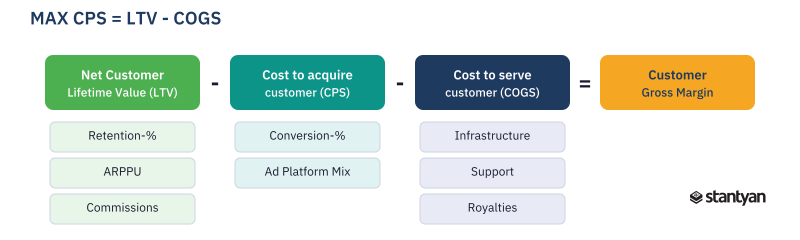
The full unit economics picture. Product quality and monetization set the ceiling (LTV), cost to serve eats into it (COGS), and what remains determines how much you can spend on acquisition (CPS).
With COGS in the equation, the maximum sustainable acquisition spend becomes:
Max CPS = Net LTV - COGS Customer Gross Margin = Net LTV - CPS - COGS. This is the true per-subscriber profit after all direct costs. If your business includes significant variable costs per subscriber - content licensing, royalties, per-seat infrastructure costs - ignoring COGS in unit economics will overstate how much you can afford to grow.
For businesses without meaningful per-subscriber variable costs (many pure SaaS products), COGS is small relative to LTV and the simpler Net LTV - CPS analysis holds. But if you operate in media, gaming, education, or any domain where content licensing or similar costs scale with subscribers, the full equation is what you need.
Connecting the system
None of these metrics exist in isolation. They form a feedback loop:
Retention drives LTV. LTV sets the ceiling for acquisition spend. Acquisition spend determines growth rate. Growth rate (plus retention) determines ARR. ARR drives valuation. And valuation determines how much capital is available to invest in product improvements that drive retention.
The teams that get this right do not optimize one metric at a time. They understand that a 5-point improvement in Month 1 retention compounds through every downstream metric - higher LTV, higher affordable CPS, faster growth, higher ARR, higher valuation. And they understand that a flashy top-of-funnel acquisition campaign that brings in low-retention subscribers can actually destroy value even while the ARR number ticks up temporarily.
The SaaS Quick Ratio captures this tension elegantly. A quick ratio that is high because of strong new ARR but weak retention is a business running on a treadmill. A quick ratio that is moderate but backed by strong retention is a business building compounding value.
So what?
Pick the one metric in this system that is currently most opaque in your business and instrument it properly this week. For most early-stage teams, that is subscriber retention segmented by cohort and billing period - not the blended average, but the actual curve. Once you can see the shape of that curve, every other decision in the system (how much to spend on acquisition, where to invest in product, whether to raise prices) gets sharper. If your LTV calculation still uses the simple ARPPU / Churn formula with an average churn rate, replace it with a retention-curve-based calculation - the difference is often 20-40%, and that gap flows directly into your acquisition budget.