Strategy
The Science of Entrepreneurship
What data, frameworks, and eight years of startup research actually tell us about building ventures that survive - from Lean Startup to AI-native teams.

What does the evidence actually say?
Most writing about entrepreneurship falls into one of two traps: inspirational storytelling that doesn’t transfer to your situation, or framework worship that treats one methodology as gospel. Neither helps much when you’re trying to figure out whether to pivot, how to validate demand, or whether your market is big enough to matter.
The science of entrepreneurship - and it is a science, with testable hypotheses, measurable outcomes, and a growing body of empirical data - tells a more useful story. It tells us that overwhelming majority of startups fail, and the primary root cause hasn’t changed in a decade: building things nobody wants. It tells us that first movers fail at nearly six times the rate of early followers. It tells us that the frameworks for building ventures have matured dramatically since Eric Ries published The Lean Startup in 2011, but the fundamental challenge remains the same.
What has changed is speed. AI-native startups now operate with teams 40% smaller than traditional companies while generating roughly $3.5 million in revenue per employee. Prototyping that took months in 2018 takes days in 2026. But the 90% failure rate hasn’t budged, which means faster tools haven’t solved the hard problems - they’ve just compressed the timeline for encountering them.
This is what the data says, and what to do about it.
Lean Startup evolved, it wasn’t replaced
Eric Ries’s five principles - entrepreneurs are everywhere, entrepreneurship is management, validated learning, innovation accounting, Build-Measure-Learn - still hold up. But the ecosystem around them has matured with complementary frameworks that address real gaps in the original methodology.
The biggest evolution concerns the MVP concept. Critics love saying “MVPs don’t work anymore,” but that misreads the problem. Ries never advocated for crappy products - the methodology prescribes picking an appropriate level of risk validation for your market. What changed is that the cost of creating a differentiated MVP increased dramatically even as the cost of writing software decreased. Figma spent four years building foundational technology before launch. That’s a very different kind of “minimum” than what a startup could ship in 2011.
Product-Led Growth emerged as the dominant go-to-market evolution. PLG companies - Slack, Notion, Airtable, Dropbox - let the product itself drive acquisition through freemium and self-service onboarding. The numbers are compelling: PLG companies grow roughly 50% faster than sales-led peers, with the best achieving 130-150% net dollar retention. Cursor hit $200 million in revenue before hiring a single enterprise sales rep. The key metrics shifted beyond user counts to time-to-value, activation rates, and natural growth from organic channels.
Teresa Torres’s Continuous Discovery framework filled the gap Lean Startup left in ongoing product development. Her core insight - minimum weekly customer touchpoints by the team building the product - transforms customer development from a one-time research project into a continuous practice. The Opportunity Solution Tree maps outcomes to opportunities to solutions to experiments, which prevents teams from jumping straight to building.
And then AI changed the math entirely. No-code tools had already cut MVP build time from months to weeks. But GitHub Copilot, Cursor, and similar tools compressed it further - 25% of Y Combinator’s Winter 2025 batch shipped codebases that were 95% AI-generated. The practical implication: founders can now test multiple solution concepts in days and iterate on real user feedback in hours. The golden rule from practitioners is straightforward - if failure could seriously damage your business, build it properly; if it’s for learning, prototype with AI and move fast.
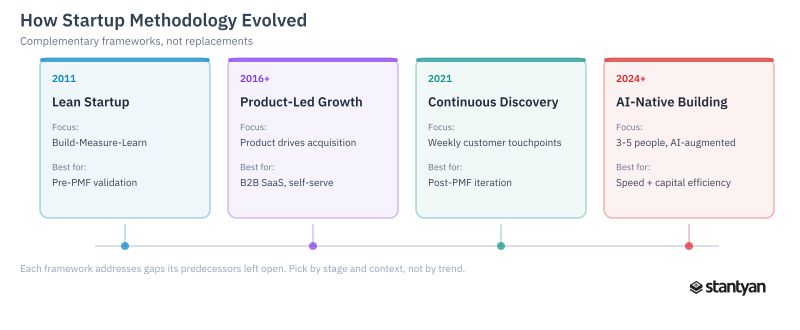
Each framework addresses gaps its predecessors left open. The right choice depends on your stage and context.
Ninety percent still fail, but we know more about why
The overall failure rate has stayed stubbornly constant: 90% of startups fail, with 21.5% gone in the first year, 48.4% within five years, and 65.1% within ten. The 2022 cohort actually fared worse - 23.2% first-year failure, the highest rate in fifteen years - as post-pandemic funded companies hit reality faster than their predecessors.
CB Insights analyzed 431 VC-backed companies that shut down between 2023 and 2025. Those companies had raised a combined $17.5 billion in equity funding before dying, with a median of $11 million per company and a median survival of just 22 months from last fundraise.
The causes overlap, and that overlap matters for reading the data correctly. “Ran out of capital” appears in 70% of failures, but it’s the terminal symptom - the final common pathway - not an independent failure mode. A startup with genuine product-market fit, with customers pulling the product out of its hands, can almost always raise more money or find a path to revenue. Capital dries up because something else went wrong first. The most common actionable root cause is no product-market fit, at 43%. Bad timing and macro conditions accounted for 29%, and unsustainable unit economics killed 19%.
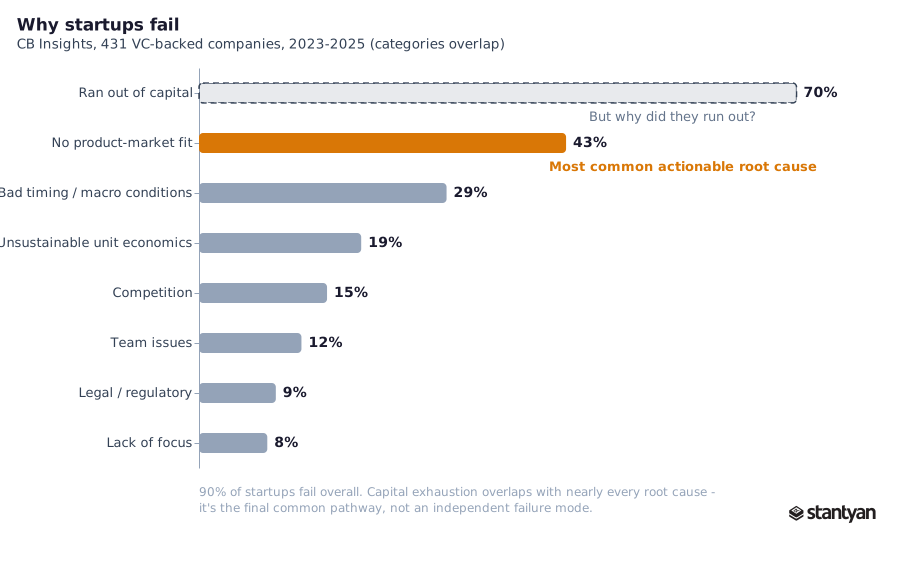
Running out of capital is how most startups die. But it’s the last symptom, not the root cause. Product-market fit failure is the most common thing that actually went wrong.
import altair as alt
import pandas as pd

# CB Insights post-mortem analysis, 431 VC-backed companies, 2023-2025
# (categories overlap). Capital exhaustion is the terminal symptom; the root
# causes are what actually went wrong underneath it.
source = pd.DataFrame(
    [
        {"cause": "Ran out of capital", "share": 70, "kind": "terminal"},
        {"cause": "No product-market fit", "share": 43, "kind": "highlight"},
        {"cause": "Bad timing / macro conditions", "share": 29, "kind": "root"},
        {"cause": "Unsustainable unit economics", "share": 19, "kind": "root"},
        {"cause": "Competition", "share": 15, "kind": "root"},
        {"cause": "Team issues", "share": 12, "kind": "root"},
        {"cause": "Legal / regulatory", "share": 9, "kind": "root"},
        {"cause": "Lack of focus", "share": 8, "kind": "root"},
    ]
)
source["label"] = source["share"].map("{}%".format)

y = alt.Y("cause:N", sort=None, title=None, axis=alt.Axis(labelLimit=240))
x = alt.X("share:Q", scale=alt.Scale(domain=[0, 82]), axis=None)

roots = alt.Chart(source[source["kind"] != "terminal"]).mark_bar(height=20, cornerRadius=4).encode(
    y=y,
    x=x,
    color=alt.Color(
        "kind:N",
        scale=alt.Scale(domain=["highlight", "root"], range=["#d97706", "#94a3b8"]),
        legend=None,
    ),
)

# The terminal symptom is drawn dashed: it ends the company, but it is the
# last domino, not the first.
terminal = alt.Chart(source[source["kind"] == "terminal"]).mark_bar(
    height=20,
    cornerRadius=4,
    fill="#64748b",
    fillOpacity=0.15,
    stroke="#334155",
    strokeWidth=1.4,
    strokeDash=[6, 4],
).encode(y=y, x=x)

labels = alt.Chart(source).mark_text(
    align="left", dx=7, fontSize=14, fontWeight=600, color="#1a1a2e"
).encode(y=y, x=x, text="label:N")

bridge = alt.Chart(source[source["kind"] == "terminal"]).mark_text(
    text="But why did they run out?",
    align="left",
    dx=40,
    dy=24,
    fontSize=13,
    color="#64748b",
).encode(y=y)

# tucked under the highlighted bar, growing rightward from mid-plot, so it
# stays fully visible at any rendering width
pmf_note = alt.Chart(source[source["kind"] == "highlight"]).mark_text(
    text="Most common actionable root cause",
    align="left",
    dy=24,
    fontSize=13,
    fontWeight=600,
    color="#d97706",
).encode(y=y, x=alt.value(alt.expr("width / 2")))

footnote = (
    alt.Chart(alt.InlineData(values=[{}]))
    .mark_text(
        text=[
            "90% of startups fail overall. Capital exhaustion overlaps with nearly every root cause -",
            "it's the final common pathway, not an independent failure mode.",
        ],
        align="left",
        fontSize=12,
        color="#94a3b8",
        lineHeight=16,
    )
    .encode(x=alt.value(0), y=alt.value(alt.expr("height + 24")))
)

chart = alt.layer(terminal, roots, labels, bridge, pmf_note, footnote).properties(
    title=alt.TitleParams(
        text="Why startups fail",
        subtitle="CB Insights, 431 VC-backed companies, 2023-2025 (categories overlap)",
    ),
    padding={"left": 16, "top": 16, "right": 16, "bottom": 48},
)

chart.save("failure-causes.svg")
The pivot data reveals something useful. Startups that pivot one to two times achieve 3.6x better user growth and raise 2.5x more money than companies that either never pivot or pivot more than twice. Three out of four successful startups didn’t succeed with their first idea. The lesson is a Goldilocks principle: strategic iteration beats both stubbornness and constant thrashing.
Industry-specific patterns vary more than you’d expect. AI startups face a 90% failure rate (higher than traditional tech’s 70%), partly because 85% of AI models fail from poor data quality and startups in the space burn capital roughly twice as fast as previous generations. Healthcare and biotech represented 14% of failures in the CB Insights dataset but destroyed $5.1 billion in capital - the highest per-company cost of failure in the analysis.
Market validation now outranks technical execution
The hierarchy of startup risk has inverted since 2018. YC’s Michael Seibel puts it bluntly: the number one cause of failure for YC companies is “thinking you have attained product-market fit when you haven’t.” Before 2020, technical execution dominated investor concerns. By 2024-2026, false positives on product-market fit became the killer, as companies scaled prematurely with increasing burn but no genuine market pull.
Andreessen Horowitz formalized this with their “Onion Theory of Risk” - ten layers to peel systematically, ranked by priority: founder risk, market risk, competition risk, timing risk, financing risk, marketing risk, distribution risk, technology risk, product risk, and hiring risk. Notice where technology and product land - positions eight and nine, below market validation, timing, and go-to-market execution. This ordering emerged from the 2021-2022 correction, which revealed that abundant capital had masked poor market fit. When funding tightened, companies with impressive technology but no real demand collapsed. And yet most technical founders still spend the majority of their energy on exactly those bottom layers - whether the architecture scales, whether the algorithm is good enough - while underweighting the market, distribution, and timing risks that are far more likely to kill them. If you’re spending 80% of your worry on “can we build it?” and 20% on “does anyone need it?”, you’ve inverted the priority order that the evidence supports.
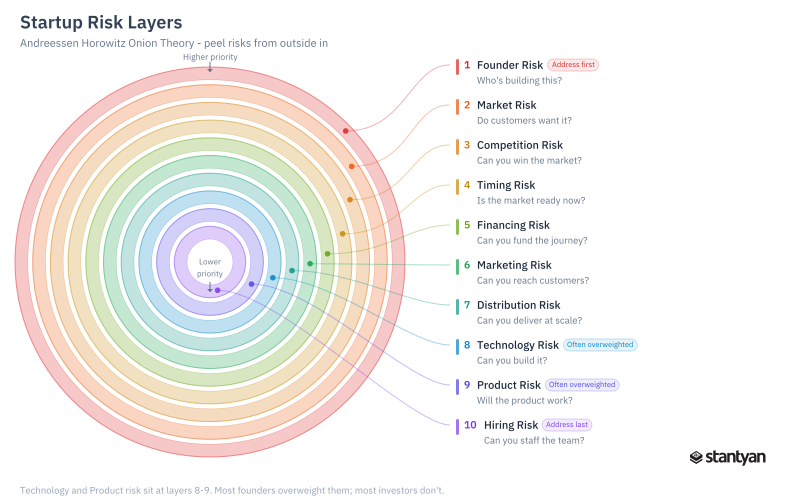
The a16z Onion Theory of Risk. Investors now evaluate market and founder risk well before they consider whether the technology works.
YC’s rapid screening framework reinforces this. With a 0.96% acceptance rate, they apply three sequential filters: communication quality (can you explain what you do in one sentence without jargon?), technical capability (must have a technical co-founder who can build the MVP), and speed with traction (evidence of rapid iteration matters more than revenue). The message is consistent: prove that people want what you’re building before worrying about how well you can build it.
New risk categories have also emerged that didn’t exist in 2018. Regulatory risk is now critical, particularly for AI startups - the EU AI Act created compliance costs estimated at $15 million or more for high-risk AI systems. Platform risk has intensified as dependence on AWS, OpenAI, and app store ecosystems creates single points of failure. And the burn multiple - cash burned divided by net ARR added - has replaced vanity metrics as the all-encompassing efficiency indicator. Benchmarks vary by stage: early stage companies under $5 million ARR can sustain 3-5x, growth stage should target 2-3x, and scale stage requires 1-2x. Companies exceeding 4x at $20 million-plus ARR struggle to raise subsequent rounds.
First to market rarely wins
This was true in 2018 and the evidence has only gotten stronger. Academic research now shows that first movers have a 47% failure rate compared to just 8% for early followers. First movers capture roughly 10% average market share while early market leaders who entered second or third achieve 28%. Entry order alone explains only 8.9% of market share variation - execution and other factors matter far more than timing.
The examples are everywhere. Instagram Stories copied Snapchat’s pioneering feature and surpassed Snapchat’s daily active users by using its existing base. Google improved Overture’s pay-per-click model to control roughly 90% of search. Samsung studied Apple’s iPhone and became the world’s largest smartphone maker by volume through classic fast-follower strategy.
But there’s nuance. In the AI era, data network effects create a real first-mover advantage: more users generate more data, enabling better AI, attracting more users. ChatGPT reached 100 million users in two months - the fastest-growing user base in history. On the other hand, cloning a model like ChatGPT costs roughly $100 million, and Microsoft’s first-mover AI advantage through its OpenAI partnership faded within eighteen months as competitors invested heavily.
The practical framework: being first to define a category matters more than being first chronologically. Amazon wasn’t the first e-commerce site but defined online retail. Tesla didn’t invent EVs but defined premium electric vehicles. Airbnb didn’t invent vacation rentals but defined peer-to-peer lodging. The above research from ITONICS identifies six capabilities that matter more than timing: learning velocity, rapid assumption validation, early testing infrastructure, ability to shut down weak bets quickly, portfolio integration, and market signal detection. Organizations that learn faster win regardless of when they enter.
Size your market from the bottom up
The approach to Total Addressable Market analysis has shifted decisively from top-down industry reports to bottom-up customer counting. VCs now expect convergence between both methods within plus or minus 15%, and large divergence signals flawed assumptions. Sequoia’s Doug Leone asks every pitch: “What percentage of the Fortune 2000 will ultimately buy this product, and how much will they be worth to you on average?”
The old approach - pulling a number from Gartner or Forrester and claiming a slice - doesn’t cut it anymore. Every assumption needs a verifiable source. Industry reports from Statista, IBISWorld, government data from Census Bureau filings, bottom-up counts from LinkedIn Sales Navigator and Crunchbase - if you don’t cite your source, the VC assumes you made it up.
More importantly, it’s not the TAM you start with - it’s the TAM you exit with. Shopify is the canonical example. When angel investor John Phillips put in $250,000 at a $3 million valuation in 2007, VCs passed because they saw maybe a $100 million market for tools serving 40-50K online stores. Shopify’s TAM grew from $46 billion in 2015 to roughly $1 trillion in 2024 through payments, marketing tools, fulfillment, B2B commerce, and international expansion. The number of digital storefronts grew 300x while Shopify captured more value per store through ecosystem lock-in.
Vertical markets deserve more credit than they got in 2018. Euclid VC’s analysis shows vertical software companies have TAMs only 10% smaller than horizontal peers while often demonstrating stronger network effects and defensibility. Toast (restaurants), Procore (construction), and Veeva (pharma) validate that vertical specialization can produce outsized outcomes. The minimum TAM for venture scale remains around $1 billion for seed stage with a plausible path to unicorn, while $5-10 billion can support $100 million-plus ARR outcomes.
AI compressed timelines while raising the bar
AI-native startups now achieve $3.48 million in revenue per employee - six times higher than traditional SaaS - while operating with 40% smaller teams and reaching unicorn status a full year faster. The enterprise GenAI market hit $37 billion in spending in 2025, growing 3.2x from the prior year, with coding emerging as the first killer use case at $4 billion annually.
The impact on team structure is significant. 50% of developers now use AI coding tools daily. Teams report 15% or greater velocity gains across the development lifecycle. GitHub Copilot users report up to 75% higher job satisfaction and 55% higher productivity. One founder used GitHub Copilot’s coding agent to implement three completely different UX themes simultaneously - parallel prototyping that was impossible with manual development. Perplexity typically assigns two to three people per project. The pattern validates something concrete: lean teams of three to five highly technical people can accomplish what previously required twenty or more engineers.
AI-moderated interviews have also transformed customer research. Tools like Outset, and HeyMarvin enable 50-100 simultaneous interviews instead of sequential manual conversations. As one Microsoft Copilot researcher noted, running 50 research sessions that previously required weeks now happens while you’re on a long flight. This compresses the customer discovery loop that Lean Startup always prescribed but that most teams struggled to sustain.
But the paradox is real. It’s easier to start than ever - three technical founders can accomplish what required twenty in 2018. And it’s harder to build lasting businesses because competitive moats from technology alone erode within months. First-mover advantage in AI lasts perhaps twelve to twenty-four months before followers catch up. Network effects and ecosystem lock-in remain the only sustainable defenses. The companies winning in 2026 combine AI-enabled efficiency with timeless fundamentals: obsessive customer focus, category definition, and strategic patience.
The literature reflects this maturation. The massive success of “The Almanack of Naval Ravikant” - over a million copies, available free online - captured the shift toward wealth building as a learnable skill and sustainability over hypergrowth. Sahil Lavingia’s “The Minimalist Entrepreneur” advocates profitable startups without traditional VC, practicing what it preaches by raising from 7,000 Gumroad creators as investors. Paul Graham’s “Founder Mode” essay sparked widespread discussion about scaling without losing garage energy. Lenny Rachitsky’s newsletter reached over 1,100,000 subscribers, becoming the definitive voice in product management. The shift from “Zero to One” to these voices signals philosophical maturity: profitability as strength, community-first development, and the rejection of hypergrowth at all costs.
So what?
Pick one thing from this list and do it this week. If you’re pre-product-market-fit, run five customer conversations using an Opportunity Solution Tree to map what you hear - not to confirm what you already believe, but to find the gaps. If you’re post-PMF, calculate your burn multiple (cash burned divided by net ARR added) and check whether you’re in the healthy range for your stage. If you’re sizing a market, build the bottom-up model with cited sources before you touch a single top-down industry report. The science of entrepreneurship keeps producing the same core finding: most startups don’t fail from bad execution, they fail from building things nobody wants. Every framework, metric, and AI tool on this page exists to help you discover that faster and cheaper - before the money runs out.